Apply for Business Vehicle Finance Pre-Approval
Buying a ute, van or car through your business? Tell us the vehicle, your ABN and GST details, and we will match you to the structure and lenders that suit your cash flow.
Your ute or van is how the work gets done, so its repayments need to sit comfortably against the jobs it brings in. Compare chattel mortgage, hire purchase and leases on GST credits, the ATO car limit and repayments, then apply once.
Side by side for utes, vans, cars and light trucks, so you can weigh owning against leasing. Buying a specific vehicle? Start with our commercial vehicle finance page.
Swipe to compare all four
| Feature | Chattel mortgageWidely used | Hire purchase | Finance lease | Operating lease |
|---|---|---|---|---|
| Best for | GST-registered businesses and tradies | Businesses wanting ownership on the final payment | Lower repayments with a residual at term end | Fleets wanting a fixed refresh cycle |
| Deposit | $0 for prime applications | $0 for prime applications | $0 for prime applications | Set by the lessor |
| Term | 1-7 years | 1-7 years | 2-5 years | 2-5 years |
| GST | Claim upfront if GST‑registered | Claim upfront if GST‑registered | On each payment | On each payment |
| Own at end | Yes | On the final payment | Buy for the residual if the lender agrees | Return the vehicle |
| Balloon | Optional, set by lender | Optional, set by lender | Residual agreed at the start | None |
| Documents | Financials or BAS | Financials or BAS | Financials or BAS | Financials or BAS |
Illustrative example: a $66,000 one-tonne dual-cab ute over 5 years, structured three ways.
Indicative only. Repayments calculated at 8.5% p.a. over 60 months, payments in arrears, 29 October 2026. Not a quote or offer. Excludes fees and tax effects; tax outcomes are general information only, confirm with your accountant.
Every trade works its vehicle differently, so lenders look at the work it does. Select your industry to see the vehicles businesses like yours usually finance.
How each vehicle type is usually financed, from dual-cab utes to light trucks.
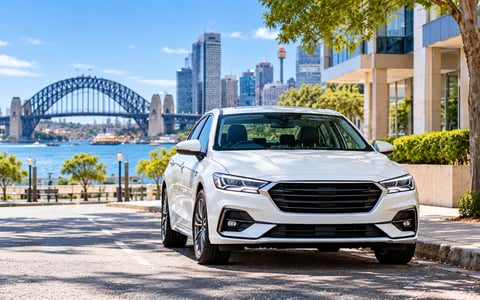
Sedans, SUVs and 4x4s for business use, where the ATO car limit usually applies.
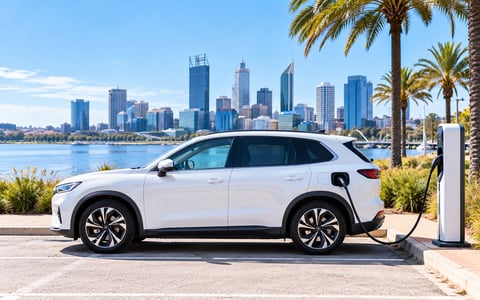
Battery electric cars and SUVs for business use, with FBT rules to check if staff drive them.
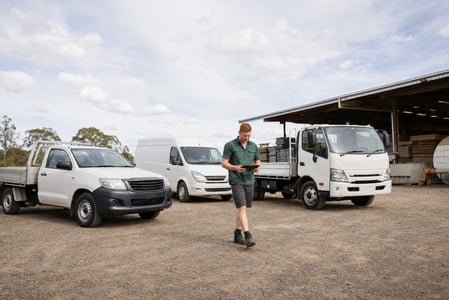
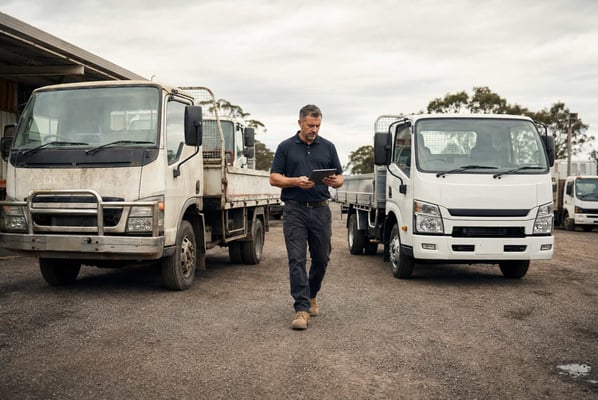
Cab‑chassis light trucks for trades and metro delivery, usually on a chattel mortgage.
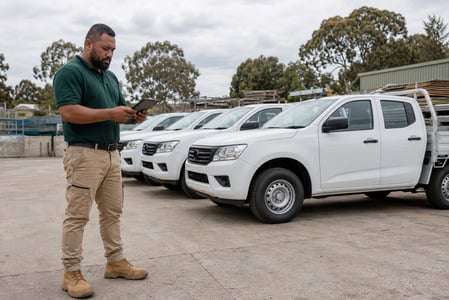
Several utes, vans or cars financed together and refreshed on a regular cycle.
Banks, dealer and manufacturer finance, specialist asset lenders and finance brokers all offer them.
EF Financial Group Pty Ltd ACN 647 510 790 CRN 530270 Authorised under Australian Credit Licence Number: 389328.

Buying a ute, van or car through your business? Tell us the vehicle, your ABN and GST details, and we will match you to the structure and lenders that suit your cash flow.


Straight answers on chattel mortgage, hire purchase, leasing and the ATO car limit for business vehicles.
For most GST-registered Australian businesses, a chattel mortgage is the most widely used business vehicle finance option. You own the ute, van or car from day one, can claim the GST in the purchase price as a credit upfront (capped for cars over the ATO car limit), and can use a balloon to lower monthly repayments over terms of 1 to 7 years. Businesses that replace vehicles on a fixed cycle often use an operating lease instead. General information only; confirm the right structure with your accountant.
Asset finance lenders fund most vehicles used in a business, including single-cab, dual-cab and tray-back utes, small and large vans, refrigerated vans, sedans, SUVs and 4x4s, electric cars and cab-chassis light trucks, one at a time or as a fleet. New and used vehicles can be financed, including private sales, subject to valuation and lender assessment.
The difference between a chattel mortgage and a finance lease for a business vehicle is ownership. Under a chattel mortgage you own the vehicle from day one, the lender registers its security interest on the PPSR until the loan is repaid, and a GST-registered business can claim the GST upfront. Under a finance lease the lender owns the vehicle, you make lease payments with GST on each payment, and at the end the residual is payable: you can pay it and buy the vehicle if the lender agrees, refinance it, or return the vehicle and settle any shortfall. Confirm the tax treatment with your accountant.
Financing a work vehicle keeps cash in the business for wages, materials and tax, and under a chattel mortgage a GST-registered business still claims the GST credit upfront, the same as when paying cash. Paying cash avoids interest, but ties up money the business may need between jobs. Compare the total interest with what that cash is worth to your business elsewhere. General information only; confirm with your accountant.
Used utes, vans and cars can be financed in Australia, including private sales (see commercial vehicle finance). Many banks limit how old a vehicle can be at the end of the loan term, while specialist asset finance lenders consider older and ex-fleet vehicles case by case, based on your profile and the vehicle's age, kilometres and valuation. Older vehicles may need a deposit. Subject to lender assessment.
Business vehicle finance lenders usually ask for four things: your ABN, how long it has been active and whether the business is registered for GST; the vehicle details from a dealer quote, invoice or private sale, with the make, model, year and kilometres; recent BAS or business bank statements, with full-doc applications also asking for financials and tax returns; and any current loans or leases, so new repayments can be planned around them. Low-doc options need less. Subject to lender assessment.
Equifund takes one application and matches it to the lenders on its panel that suit your profile, including banks, second-tier lenders and specialist asset finance lenders. Matching looks at your credit, trading history, the vehicle's age and use, your deposit and GST status, so you only apply once. Pre‑approval is obligation-free, and fees, rates and terms are set by the lender and confirmed in writing before you sign.
The ATO car limit applies only to cars, which the ATO defines as motor vehicles designed to carry a load under 1 tonne and fewer than 9 passengers. Utes and vans designed to carry 1 tonne or more are not cars, so the limit does not cap their depreciation or GST credit; check the payload in the manufacturer's specifications, as many dual-cab utes sit close to 1 tonne. For cars, the limit is $69,883 for 2026-27, according to the ATO. General information only; confirm with your accountant.
GST-registered businesses can generally claim the GST in a business vehicle's price as a credit upfront: for a chattel mortgage in the BAS for the period of purchase, and for a hire purchase agreement entered into from 1 July 2012 in the period of the first payment or tax invoice, according to the ATO. For a car costing more than the car limit, the credit is capped at one-eleventh of the limit, which is $6,353 for 2026-27. On a $66,000 one-tonne ute used fully for business, a GST-registered business can generally claim the full $6,000 of GST. General information only; confirm with your accountant.
Luxury car tax applies when a car's GST-inclusive value is above the LCT threshold, which for 2026-27 is $91,661 for fuel-efficient vehicles and $80,809 for other vehicles, according to the ATO. The tax is 33% of the amount above the threshold, and the GST credit cannot be claimed on the LCT itself. Commercial vehicles designed mainly to carry goods rather than passengers are generally not subject to LCT, but whether a dual-cab ute counts depends on its design, so check high-spec dual-cabs priced above the threshold. Check the vehicle with the dealer and your accountant.
A business can finance an electric car on a chattel mortgage, hire purchase or lease like any other vehicle, and the ATO car limit applies to its depreciation and GST credit. If the car is provided to an employee for private use, it can be exempt from fringe benefits tax when it is a zero or low emissions vehicle, was first held and used on or after 1 July 2022, and was below the fuel-efficient LCT threshold at its first retail sale, according to the ATO. Plug-in hybrids stopped qualifying from 1 April 2025, except under some existing commitments. Confirm eligibility with your accountant.
Business vehicles are deducted as they decline in value over their effective life, for the business-use portion only. Eligible small businesses with aggregated turnover under $10 million can use the simplified depreciation pool, deducting 15% in the first year and 30% of the pool balance each year after, and can immediately deduct assets costing less than the instant asset write-off threshold, $20,000 and permanent from 1 July 2026, according to the ATO. For cars, depreciation is capped at the car limit. Confirm with your accountant.
Business vehicle finance costs are generally tax-deductible for the business-use portion. Under a chattel mortgage or hire purchase, the interest and depreciation are generally deductible; under a lease, the lease payments are generally deductible instead. If the vehicle is also used privately, only the business share can be claimed, so keep a logbook. General information only; confirm with your accountant.
Business vehicle finance repayments depend on the amount, term, rate and balloon. As an illustration, on a $66,000 one-tonne dual-cab ute at 8.5% p.a. over 5 years, a chattel mortgage with no balloon is about $1,355 a month, and a 30% ($19,800) balloon brings it to about $1,090 a month, with the balloon owing at the end. Compare the total cost, including fees, not just the monthly figure. Indicative only, not a quote or offer.
Lenders set business vehicle finance rates from their own cost of funds, which moves with the RBA cash rate, plus a margin, then adjust for your credit file, time trading, deposit, loan amount, the vehicle's age and the structure. A new ute from a dealer usually prices sharper than an older vehicle bought privately. Published chattel mortgage rates in Australia start from around 7.5% p.a. and can reach 20% p.a. or higher for some borrowers, depending on the credit profile and the asset (money.com.au, October 2026). Business finance often has no comparison rate, so compare the total cost in dollars, including fees. Indicative only, not a quote, offer or rate guarantee.
A balloon on business vehicle finance is a lump sum due at the end of the loan term, a percentage of the price set by the lender based on the term and the vehicle's age, that lowers your monthly repayments, as in the repayment example above. At the end you can pay it out, refinance it or trade the vehicle in, so set it at a level the vehicle is likely to be worth by then. Indicative only, subject to lender assessment.
No-deposit business vehicle finance may be available for prime applications, subject to lender assessment. Lenders may ask for a deposit if your credit file is impaired, your ABN is newer or the vehicle is older or bought privately. A deposit or trade-in can also widen the lender pool and improve the rate offered.
Some specialist lenders consider business vehicle finance for ABNs registered for less than 2 years, often with a deposit, GST registration, a clean credit file or prior experience in the same industry. Established ABNs with 2 or more years of trading and GST registration usually have the widest choice of lenders. Sole traders sign the finance personally, so lenders also assess the owner's credit file and individual tax returns. Subject to lender assessment.
Business vehicle finance pre‑approval is typically issued within 24 hours* once your BAS or bank statements and the vehicle details, such as the dealer quote or the make, model and year, are provided, subject to lender assessment. Settlement timing then depends on the lender, the seller and your documents.
Refinancing an existing business vehicle loan can work when your credit or trading position has improved since you took the original loan, subject to any early payout costs on the existing loan. It can reduce repayments, combine several vehicle loans into one, or extend the term. Equifund compares your existing loan against the lender panel and only proceeds where the change suits you. Subject to lender assessment.
$0 deposit is available for prime credit applications only.
Typical prime criteria include an active ABN of 2 years or more, GST registration, a clean credit file with no recent defaults or insolvency events, demonstrated trading income supported by BAS or bank statements, and a new or late-model vehicle purchased through a recognised dealer. Loan-to-value, term, balloon, rate and fees vary by lender, asset type, age and applicant profile. Pre‑approval is an indicative offer only and is subject to a full credit and verification check by the funding lender. The information on this page is general information only and does not take into account your objectives, financial situation or needs. Consider whether it is appropriate for you before acting on it.
*Pre‑approval timeframes are indicative only and subject to lender assessment and eligibility criteria.
Sources: ATO, GST hire purchase and leasing; ATO, small business pool; ATO, car thresholds 2026‑27; ATO, electric cars exemption; ATO, $20,000 instant asset write-off; money.com.au, chattel mortgage rates, October 2026. ATO figures last checked 2 November 2026.