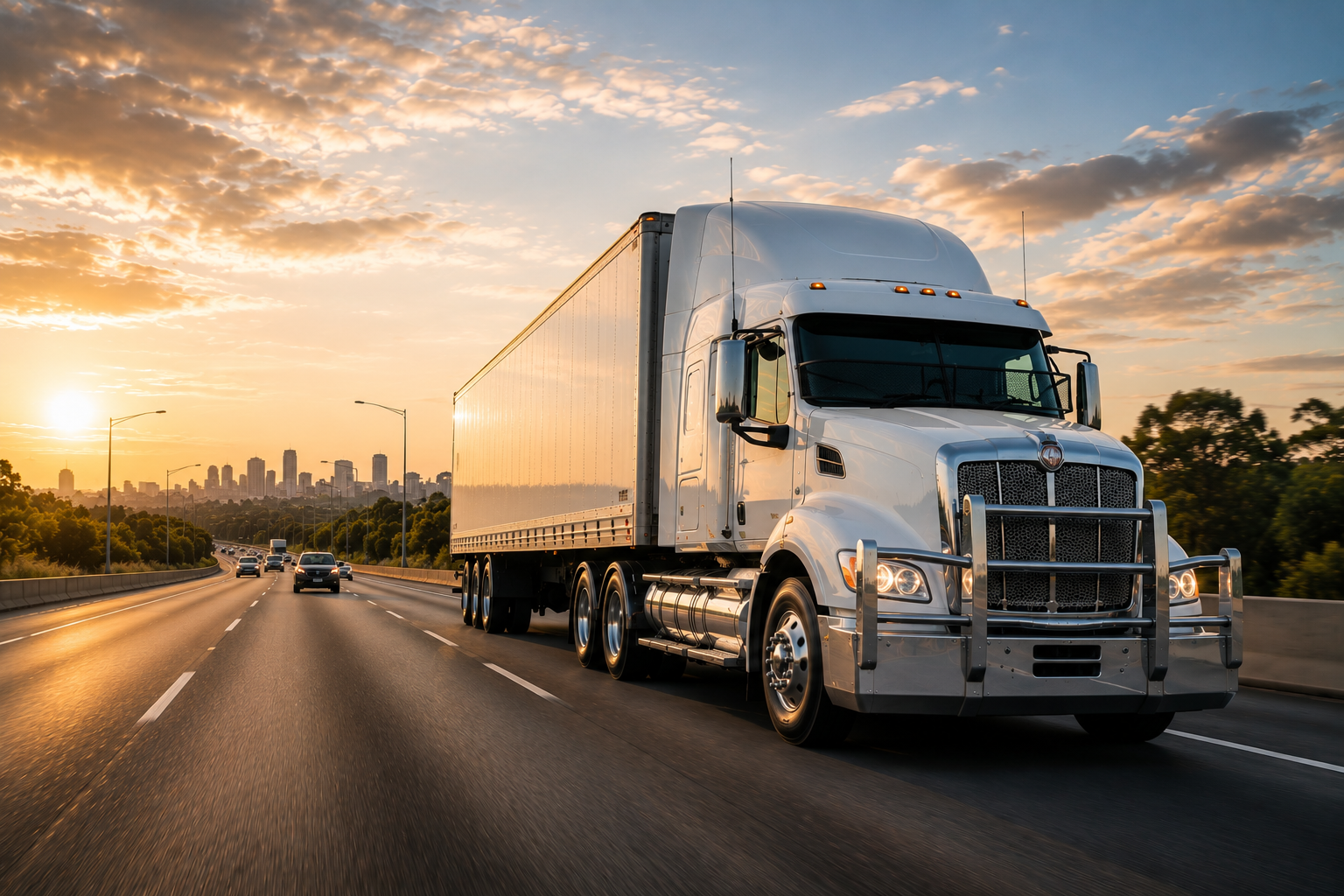

Australia's commercial truck market recorded 9,132 new deliveries across Q1 2026, with the year-on-year numbers down 11 to 13 per cent each month compared to 2025. The declines are not a sign of a struggling industry. They reflect a combination of factors: the Euro 6 (ADR 80/04) emissions standard transition, a supply of late-model used stock from high-profile operator closures in 2025, and broader economic caution across transport and construction.
For operators looking to buy, replace or upgrade trucks this year, understanding who is selling what and why matters. Here is where the market sits as of Q1 2026.
The Overall Picture: Q1 2026 by the Numbers
Australia recorded 9,132 total new commercial vehicle deliveries across January, February and March 2026. Here is how each month broke down:
- January: 2,464 units, down 11.5% on January 2025
- February: 3,003 units, down 12.9% year on year
- March: 3,665 units, down 11.2% but the quarter's strongest month
Isuzu led overall commercial vehicles with 781 sales in March alone, representing 26.1% total market share for the quarter. Kenworth held the heavy-duty top spot with 240 units in March. The transition to Euro 6 (ADR 80/04) emissions standards is influencing purchasing decisions across the fleet, with operators weighing up whether to buy now or wait for more compliant stock to arrive in volume.
Top Light Commercial Trucks: Utes and Light Vans
Light commercial vehicles continue to dominate the overall sales charts in Australia. Ford Ranger remains Australia's top-selling vehicle overall in early 2026, recording 3,403 sales in January. Toyota HiLux holds second position at 2,800 sales across the same period. These numbers reflect the continued dominance of dual-cab utes for tradespeople, farmers and small business operators who need a versatile work vehicle that doubles as daily transport.
The van segment held steady through Q1 2026, with consistent demand from delivery and logistics operators. With e-commerce volumes continuing to grow, light vans remain a practical choice for last-mile delivery businesses scaling their fleets without the capital commitment of medium or heavy trucks.
Top Medium-Duty Trucks
Isuzu is the dominant force in medium-duty, taking 228 of 419 medium-duty sales in March 2026, representing over 54% market share in the segment. That is a commanding lead over the rest of the field.
- Isuzu: 228 units in March, over 54% medium-duty market share
- Hino: 88 units in March, holding second position
- Fuso: rounds out the top three
Year-on-year declines of 32 to 38 per cent make medium-duty the most challenged segment in the current market. Operators in this segment are holding equipment longer or turning to the used market before committing to new. The combination of Euro 6 transition costs and strong late-model used supply has given buyers a credible alternative to new vehicle purchases, which is showing up clearly in the sales data.
Top Heavy-Duty Trucks: The Kenworth vs Volvo Battle
The heavy-duty segment is where the most compelling story of 2026 is playing out. Kenworth posted 196, 183 and 240 units across January, February and March (browse Kenworth trucks for sale), maintaining approximately 23% market share and holding the top position in the segment for the full quarter.
Volvo has been closing the gap steadily (browse Volvo trucks for sale). Recording 147, 141 and 221 units across the same three months, Volvo now sits at 16.3% market share in the heavy-duty segment. The trajectory is notable: both brands posted their strongest results in March, and the gap between them is narrowing. If Volvo continues its current run rate through Q2 and Q3, the Kenworth vs Volvo contest looks to be the defining theme of the 2026 heavy-duty market.
Scania and Mercedes-Benz posted solid numbers throughout Q1, maintaining their respective positions in the premium heavy-duty segment. The standout mover for the quarter was DAF, which more than doubled its January result by March and jumped from 2.5% market share in early 2025 to 6.5% in early 2026. That kind of growth in a contracting market signals genuine momentum and a growing acceptance of the DAF product among Australian fleet operators.
Key heavy-duty models seeing strong operator interest include the Kenworth T610, Kenworth T410 SAR, Volvo FH16 and Scania R-series. Each offers a different proposition in terms of payload rating, cab comfort, fuel economy and aftersales support, so the right choice depends on application, route profile and fleet size.
What is Driving the Market in 2026
Three factors are shaping buying decisions across all segments right now.
- Euro 6 (ADR 80/04) transition: The shift to new emissions standards is influencing which vehicles operators buy and when. Some are accelerating purchases ahead of stricter requirements to lock in existing stock. Others are waiting for more Euro 6 compliant inventory to arrive in volume before committing. This split in buyer behaviour is visible in the monthly sales fluctuations across Q1.
- Late-model used supply: A number of high-profile operator closures in 2025 have put quality second-hand stock into the market, giving buyers a credible alternative to new. This is suppressing some new vehicle demand, particularly in the medium-duty and light commercial segments where the price difference between new and used is most significant.
- Economic caution: Interest rates and construction sector softness are encouraging some operators to extend existing assets rather than commit to new purchases. For owner-operators and small fleets running tight margins, the calculus on a new truck purchase has changed compared to 2024 and early 2025.
Financing the Right Truck in 2026
With a year-on-year drop in new truck sales, lenders are actively competing for good quality applications. This is a buyer's market for finance right now: rates are negotiable and lender appetite is strong for operators with a solid trading history and a clear use case for the asset.
Whether you are buying new or late-model used (search available stock at Asset Scanner), the right finance structure matters as much as the interest rate itself. A few things worth knowing:
- Chattel mortgage gives you ownership of the truck from day one and lets you claim the GST component upfront on your next BAS, which improves cash flow in the short term.
- Instant asset write-off: With the $20,000 instant asset write-off confirmed until 30 June 2026, timing your purchase before EOFY can deliver a meaningful tax benefit depending on your structure. Speak to your accountant about how this applies to your situation.
- Broker access matters: A broker with access to a wide panel of specialist lenders can find the right rate for your specific truck, ABN age and trading profile. No single bank can offer that breadth of options, and the difference in rate and structure can be significant over a 3 to 5 year loan term.
Equifund works with a wide panel of specialist lenders across Australia. We are a fully licensed broker (ACN 647 510 790, Authorised under Australian Credit Licence 389328), meaning we work for you, not the bank. Get a decision in as little as 24 hours with no impact on your credit score. Apply Now
Frequently Asked Questions
What is the best-selling truck in Australia in 2026?
In the heavy-duty segment Kenworth consistently leads Australian sales, while Isuzu dominates medium and light-duty. In Q1 2026 Isuzu accounted for the largest share of total truck registrations across all weight classes combined, with strong demand in the Isuzu N-Series and F-Series from tradie and fleet buyers.
Which truck brands are growing fastest in Australia in 2026?
Chinese brands including Foton, Sinotruk and JAC are growing their share of the Australian truck market in 2026, particularly in light-duty. DAF and Mercedes-Benz are holding ground in heavy-duty. Established Japanese brands Isuzu, Hino and Mitsubishi Fuso continue to dominate overall volumes.
How do I finance a new truck in Australia?
Most ABN holders finance new trucks via chattel mortgage or hire purchase, which transfer ownership and allow you to claim GST upfront and depreciation. Terms are typically 3-5 years with a balloon payment option. A broker with a specialist truck lender panel can arrange pre-approval in 24 hours before you visit the dealership.
Can I finance a used truck in Australia?
Yes. Most lenders will finance used trucks up to 10-15 years old at time of payout, depending on lender policy. Older trucks or high-kilometre vehicles may require a larger deposit or shorter loan term. Specialist truck lenders often have more flexible age and kilometre policies than banks.
What documents do I need to finance a truck?
Standard requirements include your ABN, driver licence, 3-6 months of business bank statements, and details of the truck (make, model, year, price). For full-doc applications, lenders may also request recent tax returns or financial statements. A broker can advise which lender requires the least documentation for your situation.
Sources: Truck Industry Council (T-Mark truck sales). Figures are current at the time of writing and may change.
Disclaimer: This article is intended as general information only and does not constitute financial, tax, or legal advice. Sales data sourced from publicly available Q1 2026 market reports. Figures are current at time of publication and may change. Please consult a qualified financial adviser or accountant before making any financial decisions. Equifund Financial Group Pty Ltd | ACN 647 510 790 | Authorised under Australian Credit Licence Number 389328.