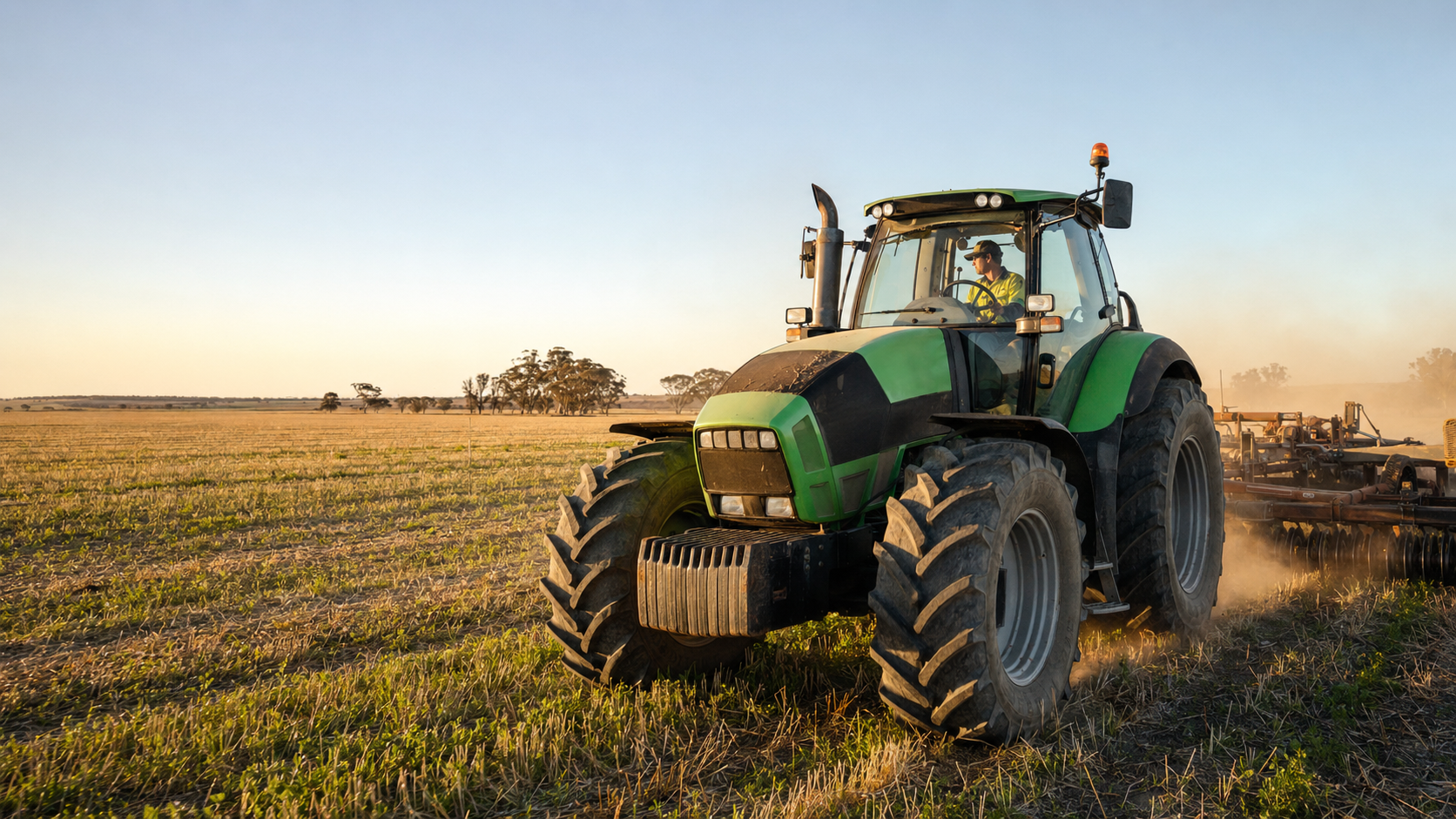

Australia's farm machinery market is heading for its quietest year in a decade and a half. Tractor sales are running 10.7 per cent behind last year at the halfway mark, and the industry is openly flagging the prospect of full-year volumes dropping below 9,000 units, a level not seen in fifteen years. Yet the paddock tells a more layered story. The 2026-27 winter crop is still forecast to be the seventh largest on record. Here is where the market actually sits in the middle of 2026, and what it means if you run gear for a living.
Where the Machinery Market Sits in Mid-2026
The Tractor and Machinery Association (TMA) numbers make the trend hard to miss. National tractor sales fell year on year in every month of the second quarter: down around 10 per cent in April, 12.5 per cent in May, and 15 per cent in June. That drags the year-to-date figure to 10.7 per cent behind 2025, and puts the full year on track for its lowest total since the early 2010s.
This is not a uniquely Australian story. Tractor sales are soft across the globe as higher manufacturing costs feed into sticker prices. But locally, dry conditions through the northern cropping belt, elevated fuel and fertiliser costs, and ongoing supply disruption have combined to make a lot of operators sit on their hands rather than upgrade. When margins tighten, a machinery purchase is the easiest decision to defer.
The Machinery Numbers Behind the Slowdown
Break the market into horsepower brackets and the caution is broad. Every segment sat in negative territory year to date by June. The small end took the heaviest hit, with under-40hp tractors down 16.1 per cent, the class most exposed to hobby farms and discretionary buyers. The workhorse 40-100hp bracket held up best at down 7.5 per cent, while the 100-200hp and 200hp-plus segments landed around 10.7 and 9.2 per cent lower. When even the big broadacre gear pulls back, it tells you commercial operators, not just lifestyle buyers, are pausing.
Not everything is red. Balers have been the standout mover of the year, running as high as 31 per cent ahead in May and still up 21 per cent for the first half. Out-front mowers jumped 12 per cent in June alone. Both point to operators spending on the jobs they cannot skip, hay and ground maintenance, while holding off on the big-ticket prime movers of the paddock. Regionally, the Northern Territory was the one genuine bright spot, up 18.9 per cent year to date and positive in every month, while New South Wales was the heaviest drag at down 17.2 per cent.
The Crop Tells a More Complicated Story
Here is where it gets interesting. Weak machinery sales might suggest a failing season, but ABARES has the 2026-27 winter crop at 54.5 million tonnes. Yes, that is down 21 per cent on last year's monster harvest, but it still sits 4 per cent above the ten-year average and ranks as the seventh largest winter crop on record. This is a step back from an exceptional year, not a collapse.
The detail matters for anyone timing an equipment decision. Wheat production is forecast to fall 26 per cent to 26.7 million tonnes, with planted area down to 10.9 million hectares, the smallest wheat footprint since 2019-20 as growers chase better margins elsewhere. Barley area actually lifted 4 per cent to 5 million hectares on stronger prices and lower fertiliser needs, even as production eases to 14.1 million tonnes. Canola is pencilled in at 6.2 million tonnes, and lentils are heading for a record 2.2 million tonnes. Growers are quietly reshaping what goes in the ground, and the machinery mix follows the rotation.
What Is Actually Driving Operator Caution
The clearest read on sentiment comes from the Rabobank Rural Confidence Survey, which dropped to a net reading of minus 48 per cent in the second quarter, its lowest point since 2006. More than half of farmers now expect conditions to worsen over the next twelve months. Rising input costs were the number one worry, cited by 60 per cent of respondents, with diesel, fertiliser and freight all under pressure. Energy security has emerged as a newer concern, flagged by around a quarter of operators who see supply disruption as a structural issue rather than a passing shock.
Confidence varies sharply by state. New South Wales was the least confident at minus 55 per cent, while Victoria slid to minus 38 per cent from near neutral the previous quarter. None of this means operators have stopped investing. It means they are more deliberate about it, protecting margins and prioritising the gear that directly earns, rather than upgrading for the sake of it.
Where Smart Operators Are Still Spending
A soft new-machinery market is not all bad news if you have work booked and need reliable gear. When demand cools, dealer floors carry more stock and used values ease off the highs of the past few seasons, which can hand a well-prepared buyer some negotiating room. It is worth watching what used tractors are listed for sale across the states as those values settle. The operators moving now are the ones replacing ageing, high-hour machines before a breakdown forces the decision at the worst possible time, mid-harvest or mid-sowing.
The brands doing the heavy lifting across Australian paddocks remain familiar: John Deere, Case IH and New Holland at the broadacre end, Kubota and Massey Ferguson through the mid-range, and Fendt, Claas, Deutz-Fahr and Valtra holding loyal followings in specific segments. For buyers watching the market, it is worth keeping an eye on tractors for sale from verified dealers nationally as stock levels shift, alongside the current farm machinery and implement stock in the balers, headers and sprayers that are actually selling. The gear is there. The question is how you fund it without eating into a tighter season.
Financing Farm Machinery in a Softer Market
With the RBA cash rate held at 4.35 per cent through the middle of 2026, borrowing costs have at least stopped climbing, which makes it easier to lock in a repayment you can plan around. The right structure depends on how you use the machine and how your accountant treats it. A quick rundown of the common options for Australian ag operators:
- Chattel mortgage: the machine secures the loan, you own it from day one, and it is the most common structure for tractors, headers and self-propelled gear. Popular with GST-registered operators.
- Finance lease: the lender owns the asset and leases it to you, useful where you want to preserve capital and treat repayments as an operating expense.
- Hire purchase: you hire the machine and take ownership at the end of the term, a middle path between the two above.
- Low-doc finance: for established operators with 2-plus years trading, streamlined approvals without full financials on eligible deals.
- Refinance: restructure existing equipment debt to align repayments with your seasonal income cycle rather than a flat monthly schedule.
Because farm income arrives in lumps around harvest and sale, repayment timing matters as much as the rate. Seasonal and structured repayment schedules can be arranged with the right lender so the debt sits comfortably against your income cycle. Before you commit, it is worth running the numbers: our finance calculator gives you a realistic repayment in a couple of minutes, and a broker can then check that figure across a full lender panel before you sign anything.
On tax, the 2026-27 Federal Budget announced a move to make the $20,000 instant asset write-off permanent for small businesses with turnover under $10 million from 1 July 2026. As at time of writing that measure had been announced but not yet passed into law, so the position is not settled. Most tractors and headers cost well above $20,000 in any case, so they are typically depreciated or financed through a chattel mortgage rather than written off outright. Confirm your specific position with your accountant before relying on any tax treatment.
Frequently Asked Questions
Are tractor sales really falling in Australia in 2026?
Yes. Tractor sales are running 10.7 per cent behind 2025 at the halfway point of the year, according to the Tractor and Machinery Association. Sales fell year on year in every month of the second quarter, and the industry has flagged the prospect of full-year volumes falling below 9,000 units, the lowest in about fifteen years.
Is the 2026-27 winter crop as weak as the machinery market suggests?
No. ABARES forecasts the 2026-27 winter crop at 54.5 million tonnes. That is down 21 per cent on an exceptional prior year, but it is still 4 per cent above the ten-year average and the seventh largest winter crop on record. Wheat is forecast down 26 per cent to 26.7 million tonnes, while barley area and lentil production are actually rising.
Why is Australian farmer confidence so low right now?
The Rabobank Rural Confidence Survey fell to a net reading of minus 48 per cent in the second quarter of 2026, its lowest since 2006. Rising input costs were the top concern for 60 per cent of farmers, driven by higher diesel, fertiliser and freight. Energy security and dry conditions across northern cropping regions added to the caution.
Is now a good time to buy farm machinery in Australia?
If you have work booked and reliable gear is the constraint, a softer market can work in your favour. When new sales cool, dealer stock levels rise and used values ease, which can give a well-prepared buyer more negotiating room. Many operators are replacing high-hour machines now rather than risk a breakdown during harvest or sowing.
What finance options suit farm machinery?
Chattel mortgage is the most common structure for tractors and headers, with the machine securing the loan and ownership from day one. Finance lease and hire purchase are alternatives depending on how you want to treat the asset. Established operators with two or more years trading may qualify for low-doc approvals, and refinancing can align repayments with a seasonal income cycle.
Can I claim the instant asset write-off on farm machinery in 2026-27?
The 2026-27 Federal Budget announced a move to make the $20,000 instant asset write-off permanent for small businesses with turnover under $10 million from 1 July 2026, but as at time of writing that measure had not yet passed into law. Most tractors and headers cost well above $20,000 anyway, so they are usually depreciated or financed via chattel mortgage. This is general information, not tax advice. Confirm with your accountant.
Do I need property security to finance a tractor or header?
Usually no. Most farm machinery finance is secured against the machine itself rather than your home or land. Established ABN holders can often borrow without full financials under low-doc terms, though larger facilities or more complex profiles may need a deposit or additional security.
How fast can farm equipment finance be arranged?
Pre-approval can often be turned around in about 24 hours for established operators, so you can move quickly when the right machine comes up. Getting an indicative rate does not affect your credit score. Settlement timeframes are confirmed at quote stage and depend on the lender, the asset and your documentation.
How Equifund Can Help
Equifund is a specialist asset finance broker built for operators, not paperwork. We compare a wide panel of specialist lenders to match your machine, your season and your business structure, so you are not stuck with whatever your bank happens to offer. Whether you run broadacre cropping, livestock, mixed farming or contracting, we structure finance around how your income actually arrives.
- Pre-approval in 24 hours
- No impact on your credit score to get a rate
- Finance amounts up to $2M
- Owner-operators, ABN holders and company structures welcome
If a machine upgrade is on the cards this season, Get a Rate on Your Next Tractor and see where the numbers land before you buy.
Sources: Tractor and Machinery Association; ABARES Australian Crop Report. Figures are current at the time of writing and may change.
Disclaimer: This article is general information only and does not constitute financial, tax or legal advice. It does not take into account your personal circumstances, objectives or needs. Equifund Financial Group is a commercial finance broker, not a registered tax agent or licensed financial adviser. Tax treatment depends on individual circumstances and current ATO rules. Confirm with your accountant before relying on any tax position. All finance is subject to lender credit assessment, terms and conditions. Rates, lead times and product availability are indicative and current at time of writing, and may change. Market figures, sales data and forecasts cited reflect publicly available data at the time of publication.