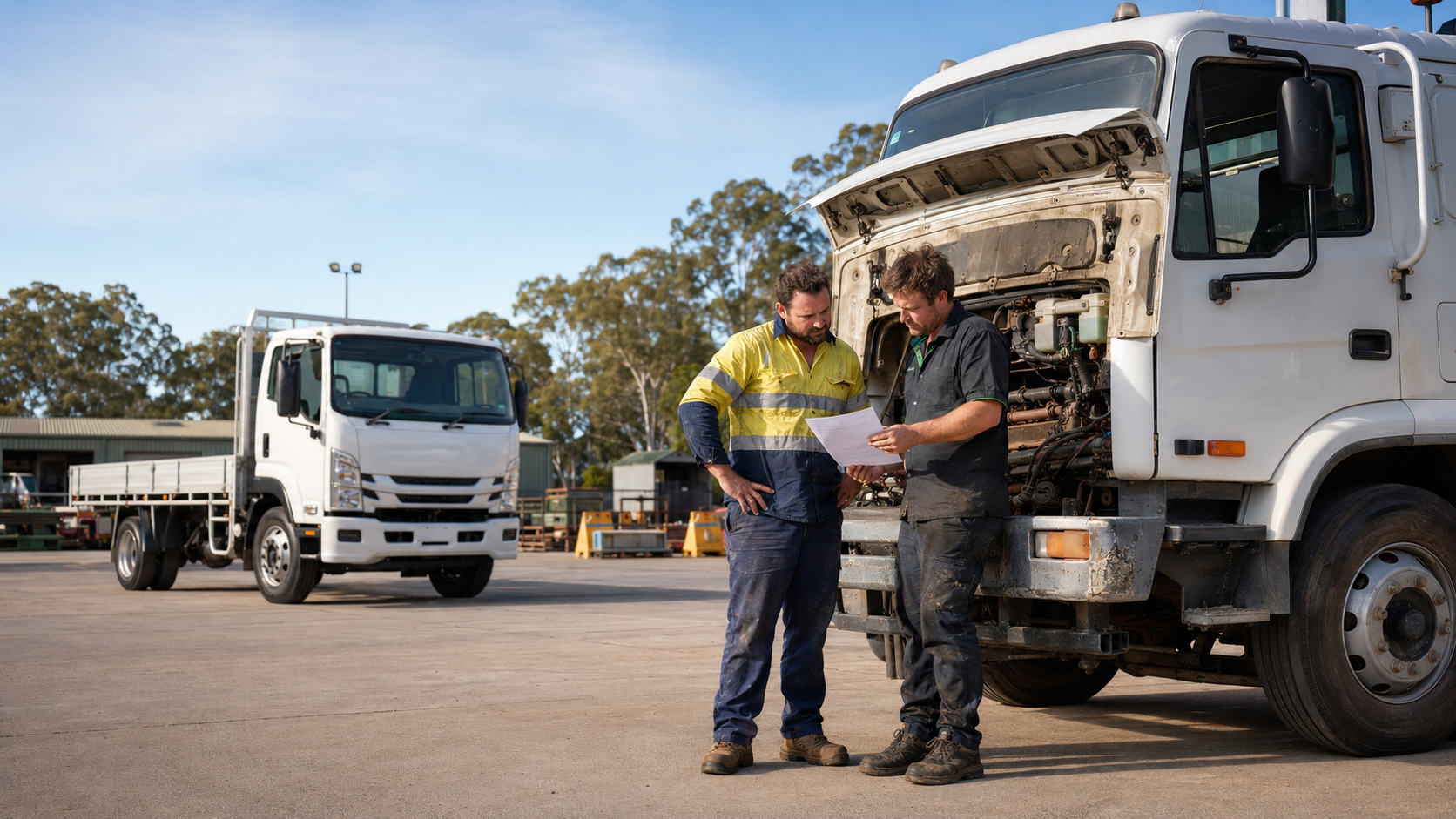

Every operator with an ageing truck, excavator or tractor is running the same maths in their head this year. Do you keep patching up the gear you own, or do you bite the bullet and replace it? With borrowing costs higher than they were twelve months ago and the new truck market down sharply, plenty of operators have chosen to hold on and hope. That is a defensible call right up until it isn't.
This is not a finance pitch dressed up as a guide. It is the actual decision framework we walk through with transport, civil and ag operators every week, backed by where the market sits in the second half of 2026. Get the timing right and you protect your margin. Get it wrong and a single driveline failure at the wrong moment can cost you more than a year of repayments.
The Market Backdrop: Why Operators Are Holding On
The new truck market has cooled hard. Australian truck sales reached 19,526 units in the first half of 2026, down 13.5 per cent on the same period last year, according to Truck Industry Council T-Mark data. Medium-duty has been the weakest link, running well behind 2025 in every month of the second quarter, while light-duty trucks have held up best on the back of steady last-mile delivery demand.
Two forces are driving the caution. First, money costs more. The Reserve Bank lifted the cash rate three times across the first half of 2026 to 4.35 per cent, then held it there, so the repayment on a replacement asset is higher than it would have been a year ago. Second, diesel has stayed stubbornly expensive on the back of global oil market pressure, squeezing operating margins before a single finance question is even asked.
The natural response is to defer. Keep the old girl going another season, dodge the higher repayment, wait for rates to ease. The problem is that deferring is not free. An ageing asset carries its own rising bill, and that bill is easy to underestimate because it arrives in dribs and drabs rather than one big repayment.
Australia Runs One of the Oldest Truck Fleets in the Developed World
Here is the number that should make every fleet owner sit up. The average Australian truck is roughly 14.8 years old, based on the most recent Bureau of Infrastructure and Transport Research Economics figures. That is old by any developed-world standard, and the Productivity Commission has been examining the ageing of the national truck fleet as a genuine safety and productivity issue.
An old fleet is not just a trucking problem. The same pattern shows up in yards full of high-hour excavators, dozers and skid steers, and in sheds housing tractors and headers that have quietly rolled past 10,000 hours. When new sales slow, the average age of everything on the road and on the job climbs further. Every year you defer a replacement, you are adding to that average and inheriting the risk that comes with it.
The risk is real and it is threefold: mechanical failure at the worst possible moment, a widening gap on safety and emissions technology, and fuel burn that a newer, cleaner engine would cut. A 2011 prime mover simply does not sip diesel the way a current Euro 6 (ADR 80/04) unit does, and that difference compounds every kilometre.
The Hidden Cost of Keeping an Older Asset Running
When operators tell us a repair "only" cost a few thousand, they are usually counting the invoice and nothing else. The full cost of running tired gear has four parts, and three of them never show up on the mechanic's bill:
- The repair bill itself: rising and increasingly lumpy as major components move out of warranty and toward end of life.
- Downtime: a truck off the road earns nothing, a civil machine idle stalls the whole job, and a header down during a narrow harvest window can cost you the crop.
- Reliability tax: the jobs you turn down, or the backup gear you hire, because you cannot fully trust the asset to turn up.
- Fuel and compliance drift: older drivelines burn more diesel and can lock you out of work where clients or sites now specify newer emissions standards.
Add those four together and the "cheap" option often is not. The mechanic's invoice might be $6,000, but two days off the road on a linehaul run, plus a hire replacement, can quietly double or triple the real number. If you are weighing a replacement, plug the numbers into the Finance Calculator and compare a monthly repayment against what the old asset is really costing you across all four buckets.
Repair or Replace: A Practical Decision Framework
There is no single magic number, but there are clear signals. Lean toward replacing when you can tick two or more of these:
- The 50 per cent test: a single repair quote approaches half the asset's current resale value, or your rolling annual repair bill is climbing past what a replacement repayment would be.
- Repeat failures: two or more unplanned breakdowns in the past twelve months, especially on core driveline, hydraulics or engine.
- Out-of-warranty big-ticket risk: the next likely failure is an engine, transmission or hydraulic pump rebuild, not a hose or a sensor.
- Work you cannot win: clients or sites are specifying newer, cleaner or safer equipment than you currently run.
- Resale is fading fast: every season you wait, the trade-in value drops faster than the repayments you are avoiding.
Lean toward repairing when the asset is fundamentally sound, the fault is isolated and cheap relative to value, the machine only works seasonally or at low hours, and a newer model would not meaningfully change your fuel bill or the work you can win. A tipper that does 15,000 low-stress kilometres a year is a very different case to a prime mover pulling 200,000.
It Comes Down to Your Asset Type
The framework flexes by how hard the asset works and how much a day of downtime hurts.
Linehaul prime movers. High kilometres, tight schedules, brutal downtime cost. These are the assets to replace earliest, because reliability directly protects your contracts. Operators tracking replacements can compare used trucks for sale from verified dealers nationally to see where used values are landing before committing.
Civil and earthmoving gear. An excavator that stops stops the whole job, and standby rates on a replacement machine add up quickly. If a core hydraulic or driveline failure is on the horizon, replacement usually wins. It is worth watching current excavators for sale to gauge the market before your machine forces the decision for you.
Tractors and headers. Seasonal use means you can often run these longer, but the calculus flips hard around a narrow sowing or harvest window. A breakdown you cannot fix in 48 hours during harvest is not a repair bill, it is a lost crop. Many growers replace high-hour gear in the quiet months rather than gamble, and browse tractors for sale from verified dealers well ahead of the season.
Utes and light commercials. The most resilient corner of the market, with firm used values and strong demand. If your work ute is racking up repair visits, replacement is usually straightforward and the trade-in will hold up. Have a look at the utes currently available to benchmark pricing.
Timing the Market in 2026
Counterintuitively, a soft new-sales market can favour a well-prepared buyer. When new registrations slow, dealer stock levels rise and used values ease, which hands negotiating room to operators who have their finance sorted and know exactly what they want. The operators winning right now are the ones who are ready to move on the right asset, not the ones waiting for a perfect signal that never comes.
On rates, the RBA has held at 4.35 per cent after its run of early-2026 increases. Waiting for a cut is a gamble on timing that most operators lose, because the asset keeps ageing and the repair bills keep coming regardless of what the cash rate does. The smarter play is to make the repair-or-replace call on the economics of the asset in front of you, then structure the finance to suit.
A Worked Example: The Numbers on a High-Hour Prime Mover
Take a 2011 prime mover at 1.3 million kilometres. Over the past year it has cost around $40,000 in repairs across three unplanned breakdowns, each one pulling it off a linehaul run for two to three days. Its realistic trade-in value sits near $45,000. The next likely failure is a major driveline job.
Run the four-bucket test. The repair bill is climbing, a single big-ticket failure would land near the asset's whole resale value, downtime has already cost real contract revenue, and a newer unit would cut the fuel bill. That is three or four boxes ticked. Replacing with a low-kilometre used replacement, financed over five years, converts an unpredictable and rising repair exposure into a fixed, plannable monthly cost, and puts a reliable asset back under a good driver. To see what a replacement of that size looks like at current rates, run it through the Finance Calculator.
Finance Structures for a Replacement
Once you have made the call, the structure should match how you use the asset and how your accountant treats it. The common options for established operators:
- Chattel mortgage: the most common structure for trucks and machinery. You own the asset from day one and it secures the loan, with the balance financed and GST claimed up front where eligible.
- Finance lease: the financier owns the asset and leases it to you, which can suit operators who prefer to treat repayments as an operating cost.
- Hire purchase: you hire the asset and take ownership at the end of the term.
- Low-doc options: for operators with two or more years trading, approvals are often possible without full financials, with the asset itself providing the security.
On tax, the 2026-27 Federal Budget announced a move to make the $20,000 instant asset write-off permanent for small businesses with turnover under $10 million from 1 July 2026, though at the time of writing that measure had not yet passed into law. Most trucks and machines cost well above $20,000 in any case, so they are typically depreciated or financed rather than written off in full. Your accountant is the right person to confirm what applies to your purchase.
Frequently Asked Questions
When should I replace a truck instead of repairing it?
Lean toward replacing when a single repair approaches half the truck's current resale value, when you have had two or more unplanned breakdowns in a year, or when the next likely failure is a major engine, transmission or driveline job. Add the downtime and lost-contract cost to the invoice, not just the parts and labour, and the replacement case often becomes clear.
How old is the average Australian truck?
Around 14.8 years, based on the most recent Bureau of Infrastructure and Transport Research Economics data. That is old by developed-world standards, and the Productivity Commission has been examining the ageing national fleet as a safety and productivity concern. A slow new-sales year pushes that average higher still.
Is 2026 a good time to buy given the market slowdown?
For a prepared buyer, a soft market can help. New truck sales are down 13.5 per cent in the first half of 2026, and when new registrations slow, dealer stock builds and used values ease. That gives operators who have their finance organised more room to negotiate on the right asset.
Should I wait for interest rates to fall before replacing gear?
Waiting is a bet on timing that most operators lose. The RBA has held the cash rate at 4.35 per cent after lifting it through early 2026, and there is no guarantee of a near-term cut. Meanwhile the asset keeps ageing and the repair bills keep coming. Base the decision on the economics of the machine in front of you, then structure the finance to suit.
How do I calculate the true cost of keeping an old machine?
Add four buckets, not one: the repair invoices, the downtime when the asset earns nothing, the reliability tax of jobs you turn down or backup gear you hire, and the extra fuel and compliance drift of an older driveline. Compare that annual total against the monthly repayment on a replacement. The old asset is usually costing more than the invoice suggests.
Do I need property security to finance a replacement asset?
Usually no. Most equipment finance is secured against the asset itself rather than your home or land. Established ABN holders with two or more years trading can often borrow under low-doc terms, though larger facilities or more complex profiles may call for a deposit or additional security.
What finance structure suits a replacement truck or machine?
Chattel mortgage is the most common structure for trucks and machinery, giving you ownership from day one with the asset securing the loan. Finance lease and hire purchase are alternatives depending on how you and your accountant want to treat the asset. The right choice depends on your structure, so it is worth a quick conversation before you sign.
How quickly can finance be arranged so I do not lose the right asset?
Pre-approval can often be turned around in about 24 hours for established operators, so you can move when the right replacement comes up rather than watching it sell. Getting an indicative rate does not affect your credit score. Settlement timeframes are confirmed at quote stage and depend on the lender, the asset and your documentation.
How Equifund Can Help
When the numbers point to replacing, the last thing you want is to lose the right asset while you sort out finance. Equifund works with a wide panel of specialist lenders, so instead of taking whatever your bank offers, we match your situation to a lender that understands your industry and your asset.
- Pre-approval in 24 hours
- No impact on your credit score to get a rate
- Finance amounts up to $2M
- Owner-operators, ABN holders and company structures welcome
Know what you want to replace? Apply Now or run the numbers on the Finance Calculator to see where you stand.
The worked example above is illustrative only. Repair costs, resale values and finance terms vary by asset, lender and individual circumstances. Confirm your own figures with your accountant and at quote stage before relying on them.
Sources: Truck Industry Council (T-Mark truck sales); Reserve Bank of Australia, Cash Rate; BITRE Road Vehicles Australia. Figures are current at the time of writing and may change.
Disclaimer: This article is general information only and does not constitute financial, tax or legal advice. It does not take into account your personal circumstances, objectives or needs. Equifund Financial Group is a commercial finance broker, not a registered tax agent or licensed financial adviser. Tax treatment depends on individual circumstances and current ATO rules. Confirm with your accountant before relying on any tax position. All finance is subject to lender credit assessment, terms and conditions. Rates, lead times and product availability are indicative and current at time of writing, and may change. Market figures, sales data and forecasts cited reflect publicly available data at the time of publication.