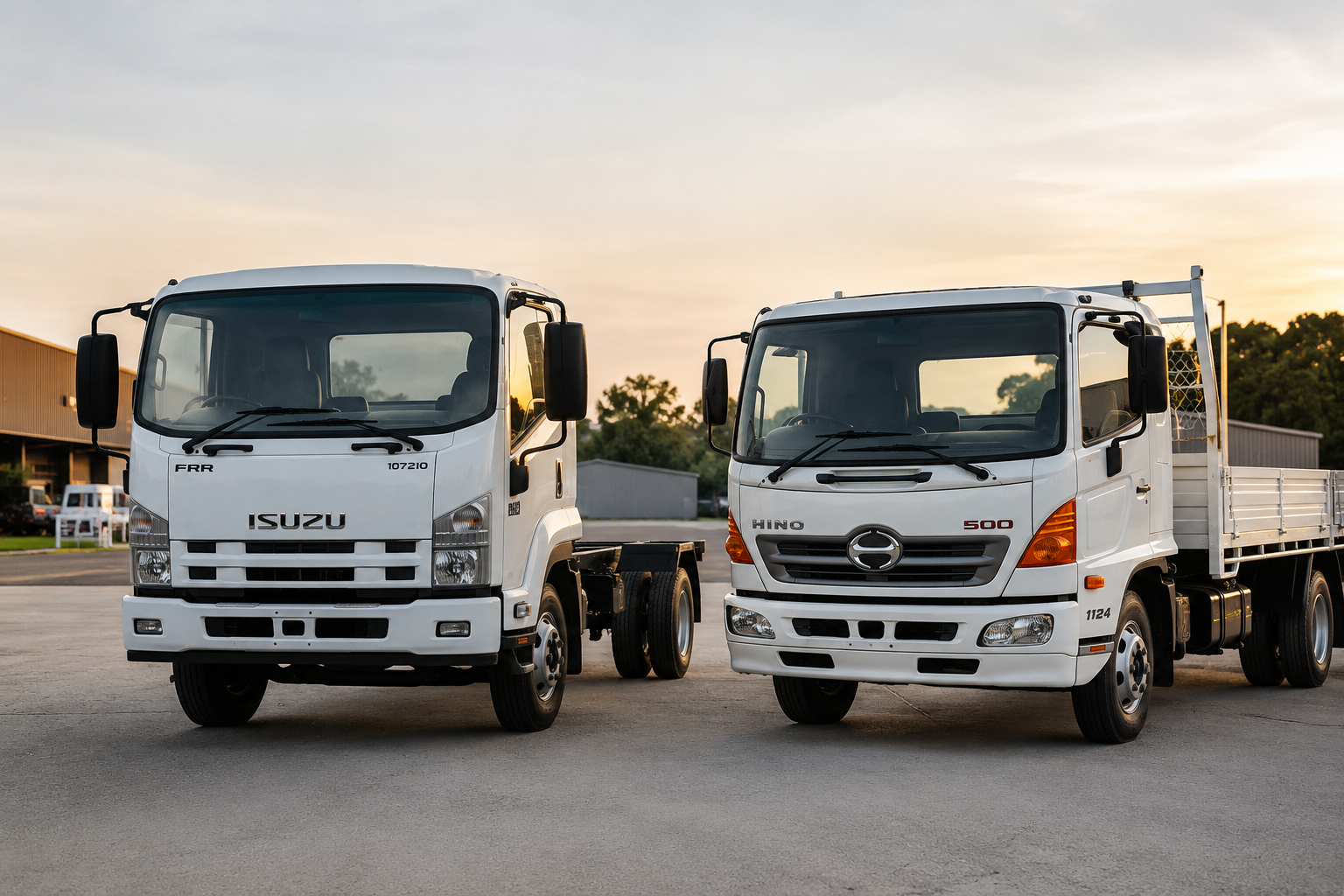

If you are buying a light or medium truck in Australia, the shortlist almost always comes down to two badges: Isuzu and Hino. Between them they own the everyday working-truck market, from the tradie tipper running suburban jobs to the metro distribution fleet doing 200 drops a day. Both are Japanese, both are bulletproof reputations built over decades, and both are sitting in dealer yards right now waiting for an operator to sign. So which one is right for your business in 2026? Here is how the two stack up on the numbers, the segments, and the things that actually cost you money once the truck is on the road.
The short answer: Isuzu is the safe all-round pick and Australia's runaway market leader, while Hino is the value challenger with the edge in hybrid. In 2025 Isuzu sold 12,420 trucks for 27.5 per cent market share, number one for the 37th year in a row, against Hino's 4,711. Isuzu wins light-duty outright with 50.6 per cent share and leads medium-duty on 49 per cent, the segment where the two are closest, while both sit behind Kenworth and Volvo in heavy-duty. Choose Isuzu for resale, dealer reach and its 6-year warranty. Choose Hino if a hybrid light truck or the 500 Series cab better suits your run.
Isuzu vs Hino at a Glance
| Category | Isuzu | Hino |
|---|---|---|
| 2025 new truck sales | 12,420 units | 4,711 units |
| Market share and rank | 27.5%, No. 1 (37th year running) | 10.4%, No. 2 |
| Light-duty (4.5 to 8t) | No. 1 - 6,941 units (50.6%) | No. 2 - 1,906 units |
| Medium-duty (8 to 16t) | No. 1 - 3,267 units (49%) | No. 2 - 2,093 units |
| Heavy-duty | No. 3 - 2,221 units (15.5%) | Outside top 3 |
| Model range | N-Series / F-Series / Giga | 300 / 500 / 700 Series |
| Hybrid electric | Available | Segment leader (record 2025, up 24%) |
| Warranty | 6-year factory + 6-year roadside | Model-dependent (confirm with dealer) |
| Dealer network | Largest in Australia, 70+ outlets | Nationwide |
| Best suited to | Resale, dealer reach, widest body options | Hybrid metro runs, cab comfort, value |
The Big Picture
The Australian truck market had a big year and then took a breather. After a record 51,277 units in 2024, total truck and heavy van sales landed at 45,191 in 2025, down close to 12 per cent. Even with that pullback it was still the third-best result on record, so this is a softer market, not a weak one. Operators are still replacing gear, just with a bit more caution about timing and rates.
Isuzu finished 2025 on top again, as it has every year since the late 1980s. That is now 37 consecutive years as Australia's number one truck brand, with 12,420 units sold and market share lifting to 27.5 per cent even as the overall market shrank. Hino held second place overall with 4,711 units. So while these two are constantly compared head to head, the gap at a brand level is real: Isuzu sells roughly two and a half trucks for every Hino. The interesting part is where that gap narrows, and where it does not.
Light-Duty: The Tradie And City Battle
This is the bread and butter for both brands, the 4.5 to 8 tonne trucks that tradies, couriers, landscapers and small fleets live on. The Isuzu N-Series and the Hino 300 Series are the direct rivals here, and it is also where Isuzu is at its most dominant.
In 2025 Isuzu sold 6,941 light-duty trucks for a record 50.6 per cent of the segment. That is more than half of every light truck sold in the country wearing an Isuzu badge. Hino came in second with 1,906 units, only just ahead of Fuso on 1,904, in a light-duty segment that totalled 13,712 trucks for the year.
For the buyer, the practical read is this. The N-Series has the widest spread of cab and wheelbase options, car-licence (Isuzu Traypack and ready-to-work) variants that let a worker drive it on a standard licence, and the deepest used market when you come to sell. The Hino 300 Series counters with a genuinely strong safety story, including a hybrid electric option that has been quietly building a following. If your runs are short, stop-start and metro, the hybrid 300 is worth a serious look. If you want maximum resale and the broadest choice of body and tray combinations, the N-Series is hard to beat. You can compare Isuzu trucks for sale against Hino trucks for sale from verified dealers nationally before you commit.
Medium-Duty: The Workhorse Class
Step up to the 8 to 16 tonne range and you are looking at the Isuzu F-Series against the Hino 500 Series. This is the freight, refrigerated, tipper and crane-truck class, and it is where Hino is most competitive.
Isuzu again led the segment in 2025 with 3,267 units for 49 per cent share. Hino was second with 2,093 units in a medium-duty segment that came in at 6,672 trucks, down 18 per cent on the year as bigger-ticket buyers held off. What stands out is the ratio: in medium-duty Hino is selling roughly two trucks for every three Isuzus, far closer than the light-duty story. The 500 Series has a loyal following among operators who rate its driveline and cab comfort for longer days behind the wheel. The F-Series brings Isuzu's parts availability and the confidence of the biggest service network in the country. For a lot of medium-duty buyers the decision genuinely comes down to which dealer they trust in their town.
Heavy-Duty: Where The Gap Widens
At the top end the story changes completely. Heavy-duty in Australia is European and American territory. Kenworth led the heavy segment in 2025 with 3,347 units and Volvo followed with 2,326. Isuzu held third overall with 2,221 heavy trucks for 15.5 per cent share, a strong result for a brand better known for its smaller gear. Hino did not make the heavy-duty top three.
The Isuzu Giga and the Hino 700 Series both play here, but for most owner-operators and metro fleets, heavy-duty is where you would also be weighing up prime movers and rigids for sale from the European and American brands. The heavy segment as a whole softened in 2025, down close to 17 per cent to 14,297 units, so this is a part of the market where buying timing and finance structure matter more than ever.
What Actually Separates Them
Once you get past the sales charts, a handful of real-world factors decide which truck earns its keep:
- Resale and used demand: Isuzu's volume advantage feeds a deeper used market, which generally supports stronger resale, especially in the N-Series light-duty range.
- Service and parts network: Isuzu runs the largest truck dealer and service footprint in Australia, with more than 70 outlets nationally, which matters most for regional operators who cannot afford a truck stuck waiting on a part.
- Warranty: Isuzu backs its trucks with a 6-year factory warranty and 6 years of roadside assist, among the strongest standard cover in the segment.
- Hybrid and electric: Hino has led the charge on hybrid electric light trucks, posting a record hybrid year in 2025 with sales up 24 per cent. If lowering fuel use on metro runs is a priority, Hino has the head start.
- New model range: Tighter Australian Design Rules on emissions triggered Isuzu's all-new MY25 range, a once-in-a-generation update to its line-up. Hino continues to expand its range, including the 700 Series, heading into 2026.
- Cab and driveline feel: Many medium-duty operators prefer the Hino 500 cab for long days, while Isuzu buyers tend to value the breadth of factory body and tray options.
How To Choose For Your Operation
Strip it back to your actual work and the decision gets simpler:
- Tradie or small fleet, metro work: N-Series for choice and resale, or a Hino 300 hybrid if your runs are short and stop-start.
- Distribution or refrigerated freight: Both are strong. Let dealer support and service location in your region break the tie.
- Tipper, crane truck or vocational: F-Series for factory body options and parts depth, 500 Series if your drivers rate the cab.
- Heavy linehaul: Cross-shop the Giga and 700 Series against Kenworth and Volvo before deciding. This is not a two-horse race at the top end.
There is no wrong answer between these two brands. They are number one and number two for a reason. The better question is which one your local dealer supports best, and how you fund it so the repayments fit your cash cycle rather than fighting it.
Financing Your Next Isuzu Or Hino
Whichever badge you land on, the finance structure does a lot of the heavy lifting on what the truck really costs you. The common options for Australian operators:
- Chattel mortgage: You own the truck from day one, the lender takes security over it, and you may claim GST and depreciation. The most popular structure for trucks.
- Finance lease: The lender owns the asset and you lease it, useful for some accounting and balance-sheet setups.
- Low doc finance: Streamlined paperwork for established 2+ year ABN holders who do not want to hand over full financials.
- Balloon or residual: Lower monthly repayments with a lump sum at the end, handy if you cycle trucks regularly.
Eligible small businesses may also be able to use the instant asset write-off on a qualifying truck purchase, subject to standard ATO rules. Our instant asset write-off guide for 2026 covers the detail, and your accountant should confirm what applies to your situation. Want to see the numbers on a specific truck? Run it through the Equifund Finance Calculator to get a feel for repayments before you talk to a dealer.
Frequently Asked Questions
Is Isuzu or Hino the bigger truck brand in Australia?
Isuzu is the clear market leader. In 2025 it sold 12,420 trucks for 27.5 per cent market share and finished number one for the 37th year in a row. Hino was second overall with 4,711 units. The gap is widest in light-duty and narrowest in medium-duty.
Which is better for a tradie, the Isuzu N-Series or the Hino 300?
Both are excellent light trucks. The N-Series offers the widest range of cab, wheelbase and ready-to-work body options plus the deepest used market, which supports resale. The Hino 300 has a strong safety package and a hybrid electric option that suits short, stop-start metro runs. Match the truck to your typical day's work.
Does Isuzu or Hino hold its value better?
Isuzu's much larger sales volume feeds a deeper used market, which generally supports stronger and more consistent resale, particularly in the light-duty N-Series. Condition, hours, service history and spec still matter more than the badge on any individual truck.
Which brand is best in medium-duty?
It is the closest contest of the lot. In 2025 Isuzu led medium-duty with 3,267 units for 49 per cent share and Hino followed with 2,093. The Isuzu F-Series wins on parts and service reach, while many operators prefer the Hino 500 cab for long days. Local dealer support often decides it.
What about heavy-duty trucks?
Heavy-duty in Australia is led by Kenworth and Volvo, with Isuzu third overall in 2025 on 2,221 units. Hino does not feature in the heavy top three. If you are buying a prime mover or heavy rigid, cross-shop the Isuzu Giga and Hino 700 Series against the European and American brands before deciding.
Is a hybrid truck worth it for my business?
If your work is short-haul, metro and stop-start, a hybrid can cut fuel use where it counts. Hino has led the hybrid electric light-truck market in Australia and posted a record hybrid year in 2025. For long-distance or constant-load work the fuel savings are smaller, so weigh it against the higher purchase price.
How do I finance an Isuzu or Hino truck?
Most operators use a chattel mortgage, where you own the truck and the lender holds security over it, with potential GST and depreciation benefits. Finance lease, low doc and balloon structures are also common. A broker with access to many lenders can match the structure to your income and the truck's age. Pre-approval and quotes are obligation-free; a brokerage fee applies on settlement and is disclosed in writing before you sign.
Can I finance a used Isuzu or Hino?
Yes. Used trucks are financed every day, though lenders apply age caps and assess the asset alongside your trading history. Established 2+ year ABN holders generally have the widest options. Getting the lender matched to the truck's age is where a broker earns its keep.
Related Reading
- Top-Selling Trucks in Australia 2026 - where Isuzu, Hino and the rest of the market sit across every weight class.
- Truck Finance vs Leasing for Growing Fleets - how to pick the right structure as you scale.
- What Is Truck Finance in Australia? - the basics of chattel mortgage, finance lease and low doc explained.
- Best Truck Finance Brokers in Australia - what to look for when choosing who arranges your finance.
How Equifund Can Help
Equifund is a commercial finance broker built for operators, not a bank queue. We have access to a wide panel of specialist lenders, which means we match the finance to the truck and to how your business actually earns, whether you are buying a near-new N-Series or a workhorse 500 Series with a few years on the clock.
- Pre-approval in 24 hours
- No impact on your credit score to get a rate
- Finance amounts up to $2M
- Owner-operators, ABN holders and company structures welcome
Found the truck? Let's get the finance sorted so you can drive it away on terms that suit your run.
Sources: Truck Industry Council (T-Mark truck sales). Figures are current at the time of writing and may change.
Disclaimer: This article is general information only and does not constitute financial, tax or legal advice. It does not take into account your personal circumstances, objectives or needs. Equifund Financial Group is a commercial finance broker, not a registered tax agent or licensed financial adviser. Tax treatment depends on individual circumstances and current ATO rules. Confirm with your accountant before relying on any tax position. All finance is subject to lender credit assessment, terms and conditions. Rates, lead times and product availability are indicative and current at time of writing, and may change. Market figures, sales data and forecasts cited reflect publicly available data at the time of publication.