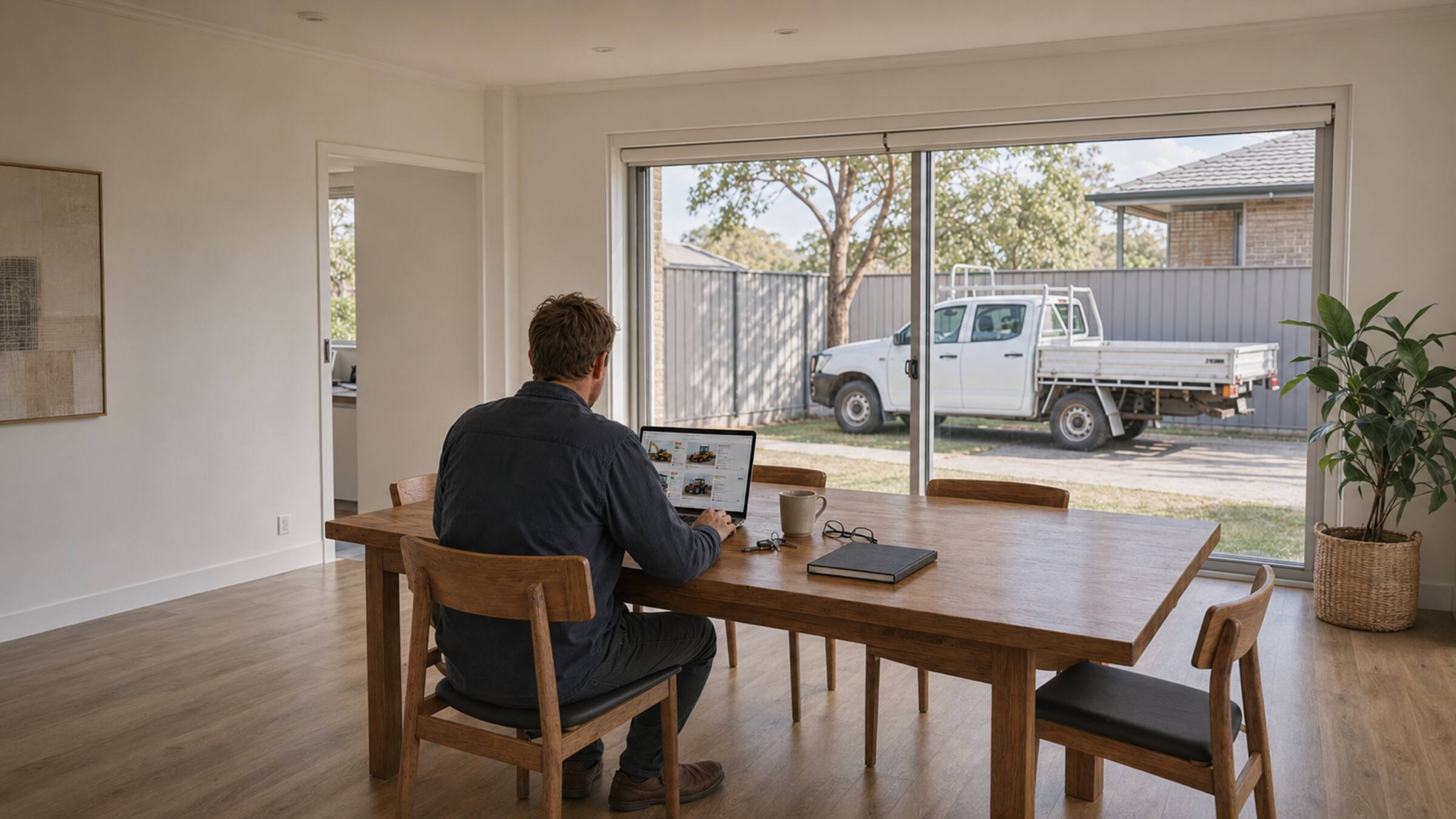

Ritchie Bros' 2026 national end of financial year program drew close to 11,000 registered bidders across ten sales. Just over 2,300 of them actually bought something. Plenty of reasons sit behind that gap, but one of them is entirely fixable: a lot of people register, turn up, and discover in the room that they do not know what they can spend. Pre-approval is the fix, and it takes a day.
Pre-approval is a lender's assessment of your business, not of a machine. It gives you a funding limit before the sale so you know where to stop bidding. It does not guarantee that any particular lot will be funded, because the asset still has to clear the lender's criteria once you have won it. Your maximum bid should sit below your limit, not at it, because the buyer's premium, GST and transport all land on top of the hammer price.
The instrument
What Pre-Approval Actually Is
Pre-approval is a credit decision made about you rather than about a machine. The lender looks at how the business trades, what it already owes and what it can service, then puts a number on it.
That number is the point. It converts an open-ended afternoon into a bounded one. You are no longer working out whether you can afford the next bid while the auctioneer is looking at you, because the arithmetic was done in an office on a weekday with your accountant's numbers in front of you.
It also gets you through the part that takes real time. Bank statements, financials and a schedule of existing commitments are not things you assemble in an hour on a Saturday, and every hour spent on them after the hammer falls is an hour of a settlement window you do not get back.
The limits
What Pre-Approval Does Not Cover
This is the part most pages skip, and it is the part worth being straight about.
Pre-approval is not a guarantee that any lot you win will be funded. The lender has assessed the borrower; it has not seen the asset, because the asset does not exist yet as far as the file is concerned. When you win, the specific machine still has to clear the lender's criteria on age, hours, identification and type.
In practice this catches people in one specific way: the approval is granted with an asset class in mind, and then the buyer bids on something quite different. An approval built around a five year old prime mover does not automatically stretch to a twenty year old dozer with no compliance plate.
The way around it is not complicated. Tell the lender what you are actually chasing, and if you are eyeing particular lots, send the lot numbers before the sale rather than the invoice after it. A five minute check beforehand is the difference between a formality and a problem. Our guide to lender age caps on used assets covers where those limits usually sit.
Sale coming up and no number to work to?
Obligation-free. No commitment to proceed.
The number
How Your Limit Gets Set
Four things do most of the work, and none of them are about the machine.
- Trading position: six to twelve months of bank statements showing how consistently money arrives and whether the account works or drowns
- Existing commitments: every facility already running, including equipment finance, because serviceability is assessed across the lot
- Lodgement currency: the most recent lodged financials, or a low doc position if the last lodgement is dated
- Deposit and structure: what you are putting in, and over what term you want to repay
Pre-approval on equipment finance is generally available within 24 hours once that file is complete. The delay, when there is one, is almost never the lender. It is waiting on a statement download or an accountant's figures.
Getting an indicative position does not affect your credit score. A formal credit check happens later, with your say-so, when there is a real asset attached.
The arithmetic
Why Your Maximum Bid Sits Below Your Limit
This is the single most expensive misunderstanding in auction buying. An approval is not a bidding budget. The hammer price is only part of what you have to pay.
Under the published Pickles auction terms, a buyer's premium is payable as a percentage of the purchase price, announced by the auctioneer before the sale, and GST is added to charges and fees. Transport off the site is yours. So is any compliance or repair work, because the lot is sold as is, where is.
Here is what that does to a $120,000 approval, using the 8.5 per cent transaction fee Ritchie Bros publishes for its Australian auctions. Rates differ between houses, so check the terms for the specific sale.
| Line | Amount | Notes |
|---|---|---|
| Your pre-approved limit | $120,000 | The ceiling on everything below |
| Winning bid | $103,000 | The number you called in the room |
| Buyer's premium | $8,755 | At the published Ritchie Bros rate of 8.5 per cent |
| Transport off site | $2,800 | Float from the yard to your depot |
| Compliance and immediate repairs | $4,500 | As is, where is, so this is your risk |
| Total to fund | $119,055 | Inside the limit, with $945 to spare |
Bid $115,000 on the same machine and the total reaches $132,075, more than $12,000 past the approval. Nothing about the machine changed. The bidder simply treated the limit as the bid ceiling instead of the all-in ceiling.
A workable rule is to set your bid ceiling around ten to fifteen per cent below your approval, then adjust once you know the premium for that sale and have a transport quote. Our breakdown of how buyer's premium works and what each house charges shows how to do that arithmetic properly. You can model the repayment on the all-in figure before the sale so the number you walk in with is the number that actually works.
Multiple lots
Bidding on More Than One Lot
Plenty of buyers go to a sale with a shopping list rather than a single target. Ritchie Bros' 2026 program averaged well over two lots for every buyer who bought, so this is the normal case, not the exception.
Say so upfront. If the lender knows you intend to bid across three lots, the limit is set for the list and the paperwork is structured once. If it does not, you end up trying to extend an approval mid-sale, which is the worst possible time to be asking.
It also changes how you bid. With a list, every dollar spent on the first lot is a dollar unavailable for the third, and knowing your total ceiling lets you decide in advance which machine you are willing to lose.
After the sale
If You Do Not Win
Nothing happens. There is no obligation to draw on a pre-approval, no cost for having had one, and no penalty for walking out empty-handed. That is worth saying plainly, because a surprising number of people avoid getting approved on the assumption that it commits them to something.
Approvals do have a shelf life, and it varies by lender and by how your position has moved, so it is confirmed when the approval is issued rather than being a fixed figure. If a sale passes and the next one is months away, expect a refresh of statements rather than a fresh application.
The other outcome worth planning for is winning the wrong thing at the right price. If the numbers no longer work once the premium and float are counted, that decision is far easier to make when you know exactly what you were approved for. It is also worth checking current excavator stock from verified dealers nationally before the sale, so you know whether the auction discount is real.
Frequently Asked Questions
How long does pre-approval take?
Pre-approval on equipment finance is generally available within 24 hours once your file is complete. Complete means bank statements, your most recent lodged financials or a low doc position, and a schedule of existing commitments. Assembling those documents is usually what takes the time, not the assessment.
Does pre-approval guarantee finance for any lot I win?
No. Pre-approval assesses the business and sets a funding limit. The specific asset still has to meet the lender's criteria on age, hours, identification and type once you have won it. If you are eyeing particular lots, send the lot numbers before the sale so fundability is checked in advance.
Does getting pre-approved affect my credit score?
Getting an indicative position has no impact on your credit score. A formal credit check happens later, with your consent, once there is a specific asset attached to the application.
How long does a pre-approval last?
It varies by lender and by whether your trading position has changed, so the validity period is confirmed when the approval is issued. If a sale passes and the next one is some months away, a refresh usually means updated bank statements rather than starting again.
What is the difference between pre-approval and pre-qualification?
Pre-qualification is an indicative view based on figures you provide, useful for a rough sense of scale. Pre-approval is an assessment against actual documents, which is what gives you a limit you can rely on in a room where the sale is unconditional.
Should my maximum bid be the same as my approval?
No. The buyer's premium, GST on charges and fees, transport off site and any compliance work all sit on top of the hammer price. A workable starting point is to set the bid ceiling around ten to fifteen per cent below the approval, then adjust once the premium for that sale is announced and you have a transport quote.
Can one pre-approval cover several lots at the same auction?
Yes, provided the total stays inside the approved limit. Tell the lender upfront that you plan to bid on multiple lots so the limit is set across the whole list and the paperwork is structured once, rather than trying to extend an approval part-way through a sale.
What happens if I get pre-approved and then do not buy anything?
Nothing. There is no obligation to draw on a pre-approval and no cost for having had one. Pre-approval and quotes are obligation-free; a brokerage fee applies only on settlement and is disclosed in writing before you sign.
How Equifund Can Help
If there is a sale date in your diary, the job is narrow and it is quick: work out what the business supports, give you a number, and sanity-check the lots you are interested in before you spend a Saturday on them. Equifund is a commercial finance broker with a wide panel of specialist lenders, and this is the part we do before anything else is discussed.
- A number before the sale: pre-approval in 24 hours on equipment finance once your file is together
- A read on the lots: send the lot numbers and we will tell you where the age and hours put them before the auctioneer starts
- Set for the whole list: bidding on three machines is a different limit to bidding on one, and it is set that way from the start
- No credit impact to get an indicative position, and no obligation if you walk away empty-handed
- Eligibility: an established ABN and a genuine business purpose, with final eligibility subject to lender assessment
Walk in knowing your number. The bidders still in it at the end are almost always the ones who did. Get Your Limit Set before you register. Pre-approval and quotes are obligation-free; a brokerage fee applies on settlement and is disclosed in writing before you sign.
Sources: Pickles Auction Terms and Conditions · Ritchie Bros 2026 national EOFY auction results · Australian Taxation Office. The worked example is illustrative only and uses an assumed buyer's premium rate; premiums are set per sale and announced by the auctioneer beforehand. Auction terms vary between auction houses and between individual sales. Figures are current at the time of writing and may change.
Disclaimer: This article is general information only and does not constitute financial, tax or legal advice. It does not take into account your personal circumstances, objectives or needs. Equifund Financial Group is a commercial finance broker, not a registered tax agent or licensed financial adviser. Tax treatment depends on individual circumstances and current ATO rules. Confirm with your accountant before relying on any tax position. All finance is subject to lender credit assessment, terms and conditions. Rates, lead times and product availability are indicative and current at time of writing, and may change. Market figures, sales data and forecasts cited reflect publicly available data at the time of publication.