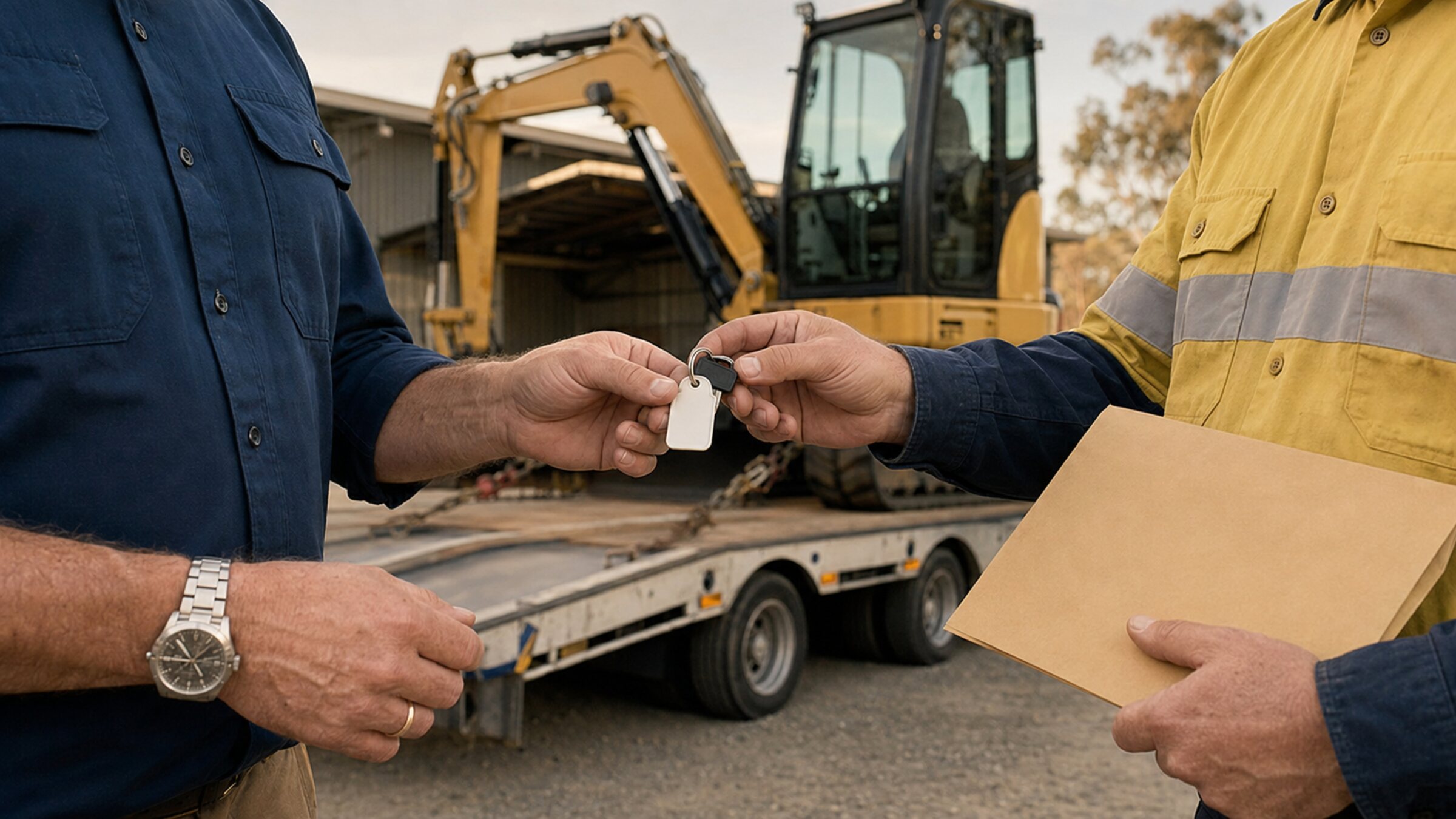

Every other way of buying a machine gives you an exit. A dealer order can be made subject to finance. A private sale can fall over on a bad inspection. An auction gives you neither. The moment the hammer drops the machine is yours, the risk is yours, and the invoice is already running. That is why auction finance is a different process to dealer finance, and why the work happens before you bid, not after.
Auction sales are unconditional. There is no cooling off period and no subject-to-finance clause, so finance has to be pre-approved before you raise your hand. Under Pickles auction terms the buyer pays a deposit immediately on the fall of the hammer and the balance within one day, on an "as is, where is" basis. Get a lender to set your limit first, take the lot details to them the moment you win, and never bid past the number you have already been approved for.
The difference
Why Auction Finance Is Not Dealer Finance
Buying through a dealer, the finance and the purchase run in parallel. You negotiate, the paperwork goes to a lender, and if the approval does not come through the deal unwinds. The finance clause is your protection.
At auction that protection does not exist. The Pickles auction terms put it plainly under a heading called "Risk falls with the hammer": all lots are bought on an "as is, where is" basis, and the buyer assumes all risk in the lot from the fall of the hammer. Nothing in that sequence waits for a lender.
So the order reverses: arrange the money, learn your ceiling, then go looking. Bidders who do this stop where they planned to. Bidders who do not are gambling that a lender they have never spoken to will fund an unassessed asset inside a window measured in hours.
The fine print
What the Auction Terms Actually Say
Few operators read an auction house's buyer terms end to end. They are short, and they are not written in your favour. These clauses, from the published Pickles auction terms, decide whether a purchase goes smoothly.
| What happens | What the terms say | What it means for you |
|---|---|---|
| The hammer falls | Risk in the lot passes to the buyer immediately, "as is, where is" | Damage, faults and condition are your problem from that second |
| Payment | Purchase price, or a deposit as agreed, payable immediately on the fall of the hammer | You need funds or a facility on the day, not next week |
| The balance | Due within one day of the fall of the hammer, or as the auctioneer specifies | This is the clause that catches people, not the deposit |
| Collection | The lot cannot be removed until the purchase price is paid in full, and must be removed within one day | Storage fees start quickly, and transport needs booking before you win |
| Late payment | Interest at the lower of 2 per cent of the purchase price per month, or the highest rate allowed by law | Delay is expensive in its own right |
| Non-payment | The sale can be cancelled, monies paid forfeited, and the lot resold, with all losses recoverable from you | You can lose the deposit and still owe the shortfall |
Read that last row again. Failing to settle does not simply cancel the purchase: the auctioneer can resell the lot without notice and recover all losses, costs and expenses from you as damages, whether or not the amount exceeds the original purchase price. A bid you cannot fund is not a mistake you walk away from.
One more clause deserves attention. The terms make it the buyer's responsibility to search the Personal Property Securities Register before bidding. If the machine carries an undischarged security interest from a previous owner's finance, that is yours to discover, not the auctioneer's to disclose.
Got a sale date and no finance in place?
Obligation-free. No commitment to proceed.
How it runs
The Order of Operations
Auction finance has a fixed sequence. Each step exists because of a constraint in the one after it.
- Get pre-approved before you register. The lender assesses you, not the machine. That produces a funding limit you can bid inside.
- Set your all-in ceiling, not your hammer ceiling. Your approval has to cover the buyer's premium, GST, transport and any compliance work, so your maximum bid sits below your approval, never at it.
- Check the lot is fundable before the sale. Age, hours and identification decide this, and a five minute check beforehand avoids a very bad afternoon.
- Run the PPSR search. The terms make this yours to do.
- Bid, and stop where you said you would. Nothing about the room changes the arithmetic you did that morning.
- Send the invoice and lot details to your broker immediately. The lender needs the specific asset to convert a pre-approval into a settlement.
- Book transport. Collection deadlines run alongside payment deadlines, not after them.
The steps most often skipped are two and three. Bidding to the top of your approval leaves nothing for the premium and the float, and by the time that lands the deal is already short.
Before the sale
What a Lender Needs Before You Bid
Pre-approval is an assessment of the business, so it works off your trading position rather than any particular machine.
- ABN and GST registration for an established, trading business
- Identification for each director or guarantor
- Bank statements covering the main trading account, generally six to twelve months
- Financials if you have them, or a low doc declaration if your last lodgement is dated
- Existing commitments, including any equipment already on finance
- The asset class you are chasing, so the lender can flag age or type limits before you waste a Saturday
Pre-approval on equipment finance is generally available within 24 hours once that file is complete, and it holds long enough to cover a sale cycle. What it does not do is guarantee funding for any lot you happen to win. The approval covers you; the asset still has to clear the lender's criteria once it exists.
That distinction matters more at auction than anywhere else, which is why step three is worth doing on the specific lots rather than the category.
After the sale
After the Hammer Falls
Winning starts a second, shorter process. The lender now has a real asset to assess and a deadline to work against.
Send the invoice and lot details through straight away: make, model, year, hours or kilometres, serial or VIN, and the settlement instructions. The invoice matters because the lender funds the total payable, premium included, not the hammer price.
Payment goes from the lender to the auction house directly, so you are not fronting the money and being reimbursed. Once cleared funds land the lot is released, which is where the transport booking earns its keep.
The variable in all of this is almost never the lender. It is how long it takes to get the invoice and lot details into their hands, which is entirely within your control and frequently lost to a weekend.
What goes wrong
Where Auction Finance Goes Wrong
Four failures account for most of the trouble, and all four are avoidable.
- Bidding without pre-approval at all. The purchase is binding whether or not a lender ever agrees. This is the one that ends in a forfeited deposit and a claim for the shortfall.
- Bidding to the approval, not below it. The premium and GST sit on top of the hammer price. An approval consumed entirely by the bid leaves the extras unfunded.
- Assuming any lot is fundable. Older machines and high-hour units attract shorter terms and larger deposits, and some assets are genuinely difficult to fund at any price. Our guide to lender age caps on used assets covers where those limits sit.
- Applying in several places at once after winning. Multiple credit enquiries in a short window are visible and they read badly, particularly alongside an auction invoice with a deadline on it.
If the machine is a replacement rather than an addition, the question of whether to buy at all is worth settling first. Our guide on repairing or replacing ageing equipment works through that call, and it is worth checking current excavator stock from verified dealers nationally to see whether the auction discount is real once the premium is added.
Structuring it
Which Structure Suits an Auction Purchase
An auction buy is funded like any other equipment purchase. The sale channel does not complicate the structure choice.
A chattel mortgage is the most common. You take ownership on settlement, the lender holds security over the machine, and you claim GST and depreciation subject to the usual ATO rules. A finance lease keeps the asset on the lender's books and suits operators who plan to hand it back and upgrade. Hire purchase sits between the two, with ownership passing at the end of the term.
What auction does change is timing. The settlement window is short, so the structure conversation belongs in pre-approval. Deciding between a chattel mortgage and a lease on the day the invoice lands is how people end up in the wrong product. Our comparison of chattel mortgage against finance lease covers the tax treatment of each, and you can model the repayment before the sale so the number is not a surprise.
Rates on equipment finance still sit against a cash rate the Reserve Bank has held at 4.35 per cent since its August 2026 meeting, so there is no cheap money arriving between now and the next sale to make a marginal bid work.
Frequently Asked Questions
Can you get finance for an auction purchase in Australia?
Yes, and it is common. The difference is sequence: the finance has to be pre-approved before you bid, because auction sales are unconditional and cannot be made subject to finance. The lender assesses your business first and sets a limit, then assesses the specific lot once you have won it.
How long do I have to pay after winning a lot?
Under the published Pickles auction terms, the purchase price or an agreed deposit is payable immediately on the fall of the hammer, with the balance due within one day, or as otherwise specified by the auctioneer. Terms vary between auction houses and between sales, so read the buyer terms for the specific auction before you register.
Does pre-approval guarantee the lender will fund any lot I win?
No. Pre-approval establishes what the business can support and gives you a bidding limit. The asset still has to meet the lender's criteria once it exists, which is why it is worth checking fundability on the specific lots you are interested in before the sale rather than after.
What is a buyer's premium and is it financed?
A buyer's premium is a percentage of the purchase price added on top of your winning bid, announced by the auctioneer before the sale begins. GST is added to charges and fees. Lenders generally fund the total payable on the auction invoice rather than the hammer price alone, which is exactly why your maximum bid should sit below your approval rather than at it.
Will a lender fund a machine sold as is, where is?
Usually, yes. As-is condition is normal at auction and does not by itself stop finance. What matters more is the asset's age and hours at the end of the proposed term, and whether it can be properly identified by serial number or VIN. Older and higher-hour machines attract shorter terms and larger deposits.
How long does pre-approval take and how long does it hold?
Pre-approval on equipment finance is generally available within 24 hours once your file is complete. The delay is almost never the lender: it is assembling bank statements, financials and existing commitments. Getting an indicative position does not affect your credit score.
What happens if I win a lot and cannot pay for it?
Under the Pickles terms the auctioneer can cancel the sale, forfeit money already paid, and resell the lot without notice, recovering all losses, costs and expenses from the buyer as damages, whether or not that amount exceeds the original purchase price. Late payment can also attract interest. It is a materially worse outcome than simply missing out on the machine.
Do I need to check the PPSR before bidding?
Yes. The auction terms make it the buyer's responsibility to search the Personal Property Securities Register before bidding. If a previous owner's finance is still registered against the machine, that is yours to find. A lender will check it too, but discovering it after you have won is far too late.
Can I finance more than one lot at the same auction?
Yes, provided the total sits inside your approved limit. Tell the lender upfront that you intend to bid on multiple lots so the limit is set for the whole shopping list rather than a single machine, and so the paperwork can be structured once instead of three separate times.
Is buying at auction actually cheaper than buying from a dealer?
Sometimes, once everything is counted. The hammer price is not the cost. Add the buyer's premium, GST on charges and fees, transport from the auction site, any compliance or repair work, and the absence of a dealer warranty. Auction can still win on price and on speed of acquisition, but the comparison has to be made on the all-in number.
How Equifund Can Help
Auction buyers ring us with a sale date, not a machine. Equifund is a commercial finance broker with a wide panel of specialist lenders, and the job before a sale is a simple one: work out what the business can support, tell you the number, and check whether the lots you are eyeing are fundable before you spend a Saturday on them.
- A limit before you bid: pre-approval in 24 hours on equipment finance once your file is together, so you walk in knowing your ceiling
- A read on the lot, not just the buyer: send us the lot number and we will tell you where the age and hours put it before the auctioneer starts
- Funding the invoice, not the hammer price: the premium and fees are part of what you actually have to pay, so they are part of what we structure
- Auction finance up to $250,000, for owner-operators, ABN holders and company structures
- Eligibility: an established ABN and a genuine business purpose, with final eligibility subject to lender assessment
If there is a sale in the next fortnight, the useful move is to get the limit set now and go in knowing where you stop. Get Pre-Approved before you register to bid. Pre-approval and quotes are obligation-free; a brokerage fee applies on settlement and is disclosed in writing before you sign.
Sources: Pickles Auction Terms and Conditions · RBA cash rate target · Personal Property Securities Register · Australian Taxation Office. Auction terms vary between auction houses and between individual sales. Always read the buyer terms for the specific auction. Figures are current at the time of writing and may change.
Disclaimer: This article is general information only and does not constitute financial, tax or legal advice. It does not take into account your personal circumstances, objectives or needs. Equifund Financial Group is a commercial finance broker, not a registered tax agent or licensed financial adviser. Tax treatment depends on individual circumstances and current ATO rules. Confirm with your accountant before relying on any tax position. All finance is subject to lender credit assessment, terms and conditions. Rates, lead times and product availability are indicative and current at time of writing, and may change. Market figures, sales data and forecasts cited reflect publicly available data at the time of publication.