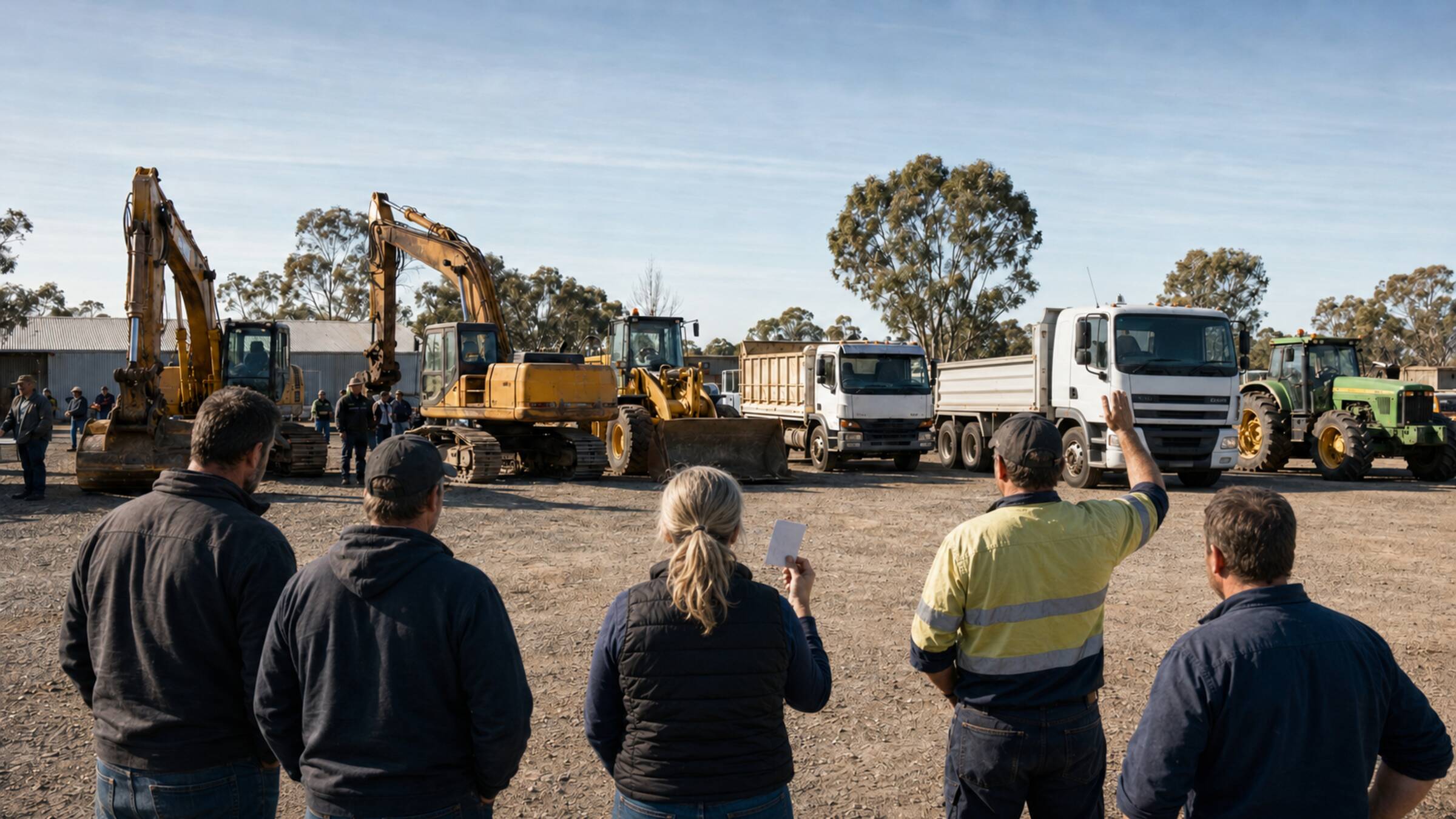

Ten auctions. 5,516 lots. More than AU$100 million changing hands in a single end of financial year run. Australia's used equipment market had its biggest auction program on record this year, and the detail underneath that headline says more about where the market is heading than any new sales figure does.
Ritchie Bros and Smith Broughton sold 5,516 lots for more than AU$100 million across ten Australian auctions in the 2026 end of financial year program, a back to back national record. Close to 11,000 bidders registered and just over 2,300 bought, from more than 20 countries. Earthmoving equipment, trucks, trailers, agricultural machinery and mining assets made up the bulk of it. The takeaway for operators: used Australian iron is now priced against a global buyer pool, not a local one.
The headline
The 2026 Numbers at a Glance
- Gross transaction value: more than AU$100 million across the EOFY program (Ritchie Bros)
- Lots sold: 5,516 across ten auctions
- Registered bidders: close to 11,000
- Actual buyers: more than 2,300, an average of roughly 2.4 lots each
- International reach: registered bidders from more than 20 countries
- Strongest domestic markets: Victoria, New South Wales and Queensland
- Largest single consignment: more than 600 assets from the Garraway Group
By category
Where the Volume Actually Sat
The program spanned earthmoving equipment, trucks, trailers, agricultural machinery and mining assets, which is a wider spread than a typical dispersal sale and tells you something about who was consigning.
Earthmoving carried the volume, as it usually does. Excavators, dozers, loaders and skid steers move fastest at unreserved auction because the buyer pool is deepest: a 20 tonne excavator suits a civil contractor in Dandenong, a quarry operator in the Hunter and a plant hire business in Toowoomba equally well. Depth of demand is what unreserved selling needs.
Trucks and trailers made up the next tranche. Prime movers, tippers and curtain siders have a narrower but more motivated buyer pool, because a transport operator replacing a unit usually has a job waiting for it.
Agricultural machinery and mining assets rounded it out. Both are lumpier: fewer lots, higher individual values, and buyers who travel for the right machine rather than buying what happens to be close.
The buyers
Who Was Actually Buying
Here is the number nobody puts in a press release. Close to 11,000 people registered to bid. Just over 2,300 of them bought something.
Roughly four in five registered bidders walked away with nothing. Some were watching for price discovery. Some were consignors keeping an eye on their own gear. But a meaningful share turned up intending to buy and did not, and if you have stood in an auction yard you know how that happens: the bidding passes the number you had in your head, and you have no idea whether you can go further.
Ritchie Bros describes its buyers as large contractors, rental companies, owner-operators and specialist subcontractors, and cites acquisition speed and depreciation avoidance as the reasons they buy used. That is a broad church, and it is worth noting that owner-operators are competing in the same room as rental fleets with treasury behind them.
Global demand
Why Australian Iron Is Now Priced Globally
Registered bidders came from more than 20 countries, including the United States, Canada, New Zealand, the United Arab Emirates and the United Kingdom, with confirmed purchases going offshore.
That changes the arithmetic for anyone buying or selling here. A well-specified Australian machine with clean hours is no longer competing for a Victorian buyer against two other Victorian buyers. It is competing against a New Zealand contractor and a buyer in the Gulf who are both looking at the same online catalogue.
Dom McGlinchey, Sales Director APAC, put the consolidation of Ritchie Bros and Smith Broughton in terms of "a larger, more connected marketplace across Australia", and the practical effect is more liquidity in both directions. Sellers get a deeper pool. Buyers get more competition.
Planning to bid at the next sale?
Obligation-free. No commitment to proceed.
What it means
What the Results Say About Your Own Resale Value
If you own the sort of gear that went through those sales, the result is a live valuation of your balance sheet whether you like it or not.
Unreserved auction is the cleanest price signal in the market, because there is no reserve to hide behind. What a machine makes on the day is what the market will pay for it that day, and those numbers are visible to anyone who looks, including the lender assessing your next application.
Three things follow. Hours and condition matter more than badge, because a buyer in another state is judging from photos and a description. Machines with a complete service history and clean identification sell better than equivalents without, since serial numbers and compliance plates are what let a buyer finance the purchase. And timing matters: EOFY concentrates supply, which is good for buyers and mixed for sellers.
If you are weighing whether to sell a machine or keep running it, our guide on repairing or replacing ageing equipment works through the numbers, and it is worth checking current excavator stock from verified dealers nationally to see what comparable machines are asking outside the auction ring.
The mechanics
What It Actually Costs to Buy at One of These Sales
The hammer price is the smallest of your problems. Every lot carries a buyer's premium as a percentage of the purchase price, announced before the sale, and GST is added to charges and fees. Transport off site is yours, and so is any repair work, because unreserved lots sell on an "as is, where is" basis.
Settlement timing varies more than most buyers expect, and it is worth checking per sale rather than assuming.
| Auction house | Payment terms | Practical effect |
|---|---|---|
| Pickles | Purchase price or agreed deposit immediately on the fall of the hammer, balance within one day | Finance has to be in place before you bid |
| Ritchie Bros (18 to 19 August 2026 national sale) | Payment in full by 27 August, removal by 3 September | Roughly a week, but still no subject-to-finance clause |
Neither set of terms gives you an out. Auction sales are unconditional, so a bid you cannot fund becomes a debt rather than a missed opportunity.
Finance
Funding a Purchase at These Prices
Because there is no finance clause, the approval has to come first. A lender assesses your business and sets a limit, you bid inside it, and the specific lot is assessed once you have won it.
Structure is the same as any other equipment purchase. A chattel mortgage gives you ownership on settlement with the machine as security. A finance lease keeps it on the lender's books. Hire purchase sits between the two. What auction changes is timing, not structure, and with the Reserve Bank holding the cash rate at 4.35 per cent since its August 2026 meeting there is no cheap money arriving to rescue a marginal bid.
Our full guide to how auction finance works in Australia covers the sequence in detail, and the pre-approval explainer covers how the limit is set.
Frequently Asked Questions
How much did Australian equipment auctions sell for in 2026?
Ritchie Bros and Smith Broughton generated more than AU$100 million in gross transaction value across ten Australian auctions in their 2026 end of financial year program, selling 5,516 lots. It was a back to back national record for the group.
What is an unreserved auction?
An unreserved auction has no minimum price and no reserve. Every lot sells to the highest bidder on the day, whatever that bid is. It produces the cleanest price signal in the market, which is why unreserved results are useful for valuing your own equipment.
Are auction prices cheaper than buying from a dealer?
Sometimes, once everything is counted. The hammer price excludes the buyer's premium, GST on charges and fees, transport from the site and any repair work, and auction lots carry no dealer warranty. Auction can still win on price and on speed of acquisition, but the comparison has to be made on the all-in figure.
Can overseas buyers bid on Australian machinery?
Yes. Registered bidders in the 2026 EOFY program came from more than 20 countries including the United States, Canada, New Zealand, the United Arab Emirates and the United Kingdom, with confirmed purchases going offshore. Australian equipment is now priced against a global buyer pool rather than a purely domestic one.
How long do I have to pay after winning a lot?
It varies by auction house and by sale, so check the buyer terms for the specific auction. Pickles terms require the purchase price or an agreed deposit immediately on the fall of the hammer with the balance within one day. Ritchie Bros set payment for its 18 to 19 August 2026 national sale at 27 August, with removal by 3 September.
Why did so many registered bidders not buy anything?
Close to 11,000 registered and just over 2,300 bought, so roughly four in five did not. Some register to watch prices or monitor their own consigned gear. Others intend to buy and stop bidding because they do not know what they can commit to. That second group is the one a pre-approved limit solves.
Do auction results tell me what my own machine is worth?
They are the closest thing to a live valuation available, because unreserved lots sell with no reserve to distort the price. Compare like for like on age, hours and condition, and remember that machines with complete service history and clean serial or compliance identification consistently outperform equivalents without.
Can I get finance for equipment bought at auction?
Yes, but the order is reversed. Because auction sales are unconditional and cannot be made subject to finance, the approval has to be arranged before you bid. The lender assesses your business first and sets a limit, then assesses the specific lot once you have won it.
How Equifund Can Help
Auction results are useful to read and expensive to act on unprepared. Equifund is a commercial finance broker with a wide panel of specialist lenders, and for auction buyers the work is front-loaded: know your ceiling before the catalogue comes out, and know whether the lots you want are fundable before you drive to the yard.
- A ceiling before the catalogue: pre-approval in 24 hours on equipment finance once your file is together
- Auction finance up to $250,000, across earthmoving, trucks, trailers and farm machinery
- A read on the lot: send the lot number and we will tell you where the age and hours put it before the auctioneer starts
- Eligibility: an established ABN and a genuine business purpose, with final eligibility subject to lender assessment
If the next unreserved sale is on your calendar, sort the number first. See how auction finance works or talk it through before you register. Pre-approval and quotes are obligation-free; a brokerage fee applies on settlement and is disclosed in writing before you sign.
Sources: RB Global, record AU$100 million+ at Australia's EOFY auctions · Pickles Auction Terms and Conditions · RBA cash rate target. Auction terms vary between auction houses and between individual sales. Always read the buyer terms for the specific auction. Figures are current at the time of writing and may change.
Disclaimer: This article is general information only and does not constitute financial, tax or legal advice. It does not take into account your personal circumstances, objectives or needs. Equifund Financial Group is a commercial finance broker, not a registered tax agent or licensed financial adviser. Tax treatment depends on individual circumstances and current ATO rules. Confirm with your accountant before relying on any tax position. All finance is subject to lender credit assessment, terms and conditions. Rates, lead times and product availability are indicative and current at time of writing, and may change. Market figures, sales data and forecasts cited reflect publicly available data at the time of publication.