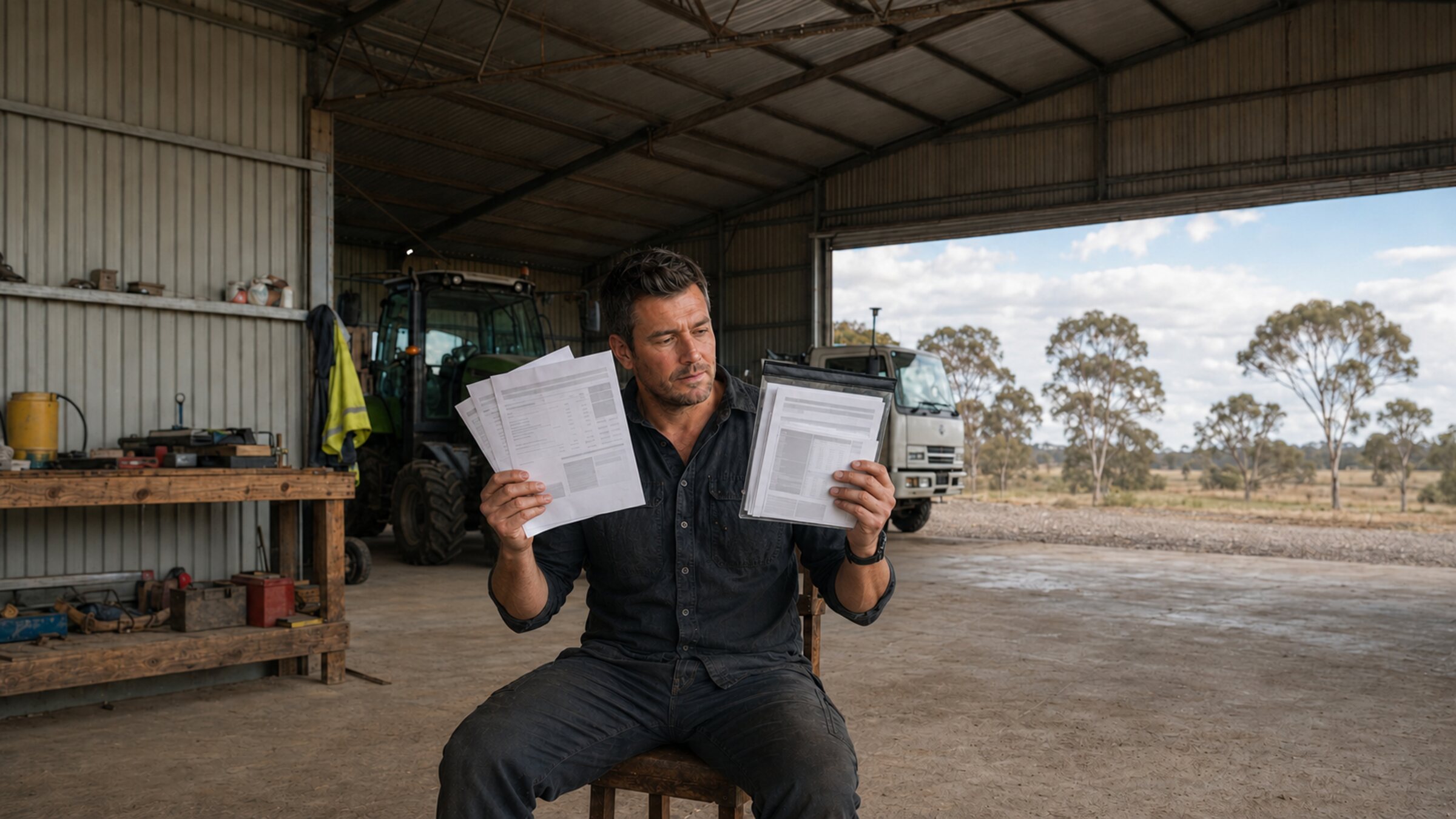

Business finance applications rarely fail on the numbers. They fail because the file arrives incomplete, the purpose is vague, or something turns up in the background that was never explained. Most of that is fixable before you apply. This is what a lender is actually reading, in the order they read it, and what to have ready before you start.
Australian lenders assess a business finance application in a set order. Three gates first: an active ABN, a genuine business purpose, and no active insolvency proceedings. Then serviceability, read from six to twelve months of trading bank statements, your ATO position, your trade payment conduct, and how plainly the purpose is described. Have your ID, business registration, bank statements, latest lodged financials, ATO balance, aged receivables and payables, and existing finance commitments together before you apply.
Eligibility
Start With the Three Gates
Before anything else is assessed on a business finance application, three things get checked. If any of them fails, nothing further happens, so it is worth being honest with yourself about them first.
- An active ABN: the business must be registered and currently trading, not dormant and not newly registered for the purpose of borrowing
- A genuine business purpose: the funds must be for the business, not personal spending. Business-purpose finance is assessed and regulated differently to consumer lending
- No active insolvency proceedings: a company in administration, liquidation or under an active director penalty enforcement is not in a position to take on new debt
These are gates, not scoring criteria. Passing them does not mean the application succeeds. Failing one means it does not start. Final eligibility on any facility is subject to lender assessment.
If you clear all three, the rest of this article is the work worth doing before you apply anywhere. If you are unsure on any of them, Check the Gates With a Specialist before spending time on paperwork.
How it’s assessed
What a Lender Reads First
Once the gates are clear, assessment moves to whether the business can service the facility from actual trading. Four things do most of the work.
| What they check | What they are reading for | What weakens it |
|---|---|---|
| Bank statements | Receipts arriving consistently across six to twelve months, and an account that does not sit at zero | A trading pattern that contradicts the purpose you have described |
| ATO position | No balance, or a balance under a formal plan that is being met | A balance left to drift, now disclosed to credit reporting bureaus |
| Trade payment conduct | A clean record of paying suppliers to terms | A registered default, regardless of its size |
| Stated purpose | One specific sentence naming what the money does and over what period | "Working capital" with no detail behind it |
Bank Statements: The Shape of the Money
Usually the last six to twelve months of trading account activity. A lender is reading the shape of the money, not the balance: how consistently receipts arrive, how often the account runs to zero, and whether there are dishonours.
The pattern has to match the story. If you have said the gap is a 30-day receivables cycle, the statements should show a 30-day receivables cycle.
Your ATO Position: The Single Biggest Factor
This is the one that moves the needle most, and lenders know the numbers behind it.
31x
the national average insolvency rate, for businesses owing the ATO more than $100,000, according to CreditorWatch. At 30 June 2026, 35,361 businesses carried tax debt above the $100,000 disclosure threshold and 53.8 per cent of them were sole traders. The Australian National Audit Office counts $35.9 billion in small business collectable tax debt across 1,338,387 businesses in 2024-25, an average of $26,797 each.
A balance under a formal payment plan that is being met reads very differently to one left to drift. The ATO now discloses business tax debt to credit reporting bureaus, so an unmanaged balance is visible whether or not you raise it.
Trade Payment Conduct
A registered trade payment default lifts a company's likelihood of insolvency to more than ten times the national average over the following twelve months, on CreditorWatch's data. That is why a single default carries weight out of proportion to its size. If there is one on file, expect to explain it.
The Purpose, Stated Plainly
"Working capital" is not a purpose. "Covering wages and fuel across a 24-day receivables gap on three current contracts" is.
Xero Small Business Insights recorded an average 24.1 day wait to be paid in the March quarter of 2026, with invoices settled 6.9 days late. A well-described timing gap is a normal, credible thing to be funding. A vague one invites questions you will not enjoy answering.
Your sector
Your Industry Is Part of the Assessment
Lenders price sector risk before they price you. CreditorWatch tracks the share of invoices running more than 60 days overdue by industry, and it is one of the strongest forward indicators of failure, so it shapes how your file is read before a single bank statement is opened.
| Industry | Invoices 60+ days late | Insolvency rate |
|---|---|---|
| Food and beverage services | 11.37% | 2.24% |
| Electricity, gas, water and waste | 8.16% | Not reported |
| Construction | 7.15% | 1.18% |
| Transport, postal and warehousing | 7.09% | 1.24% |
| Retail trade | 6.59% | Not reported |
Late payments hit a six-year high in April 2026, the worst since January 2020, and CreditorWatch describes the cause as a three-way squeeze: debt-servicing costs, operating expenses and weak demand limiting the ability to pass costs on.
If you operate in construction or transport, assume the assessor already knows your sector runs at roughly seven per cent of invoices past 60 days. That is not a reason to expect a knock-back. It is a reason to show your own book is better than the sector average, which is exactly what a clean aged receivables listing does.
What to prepare
The Documents Worth Having Ready
Gathering these before you apply is the single biggest thing you control. An application that arrives complete moves; one that arrives in pieces stalls at every handover.
- Identification: current photo ID for each director or guarantor
- Business registration: ABN and, where relevant, ACN details, plus GST registration status
- Bank statements: the main trading account, covering six to twelve months
- Financials: most recent lodged tax return and financial statements, plus year-to-date management figures if the last lodgement is dated
- ATO position: current integrated client account balance, and the payment plan documentation if one is in place
- Aged receivables and payables: the current debtor and creditor listings, which show the timing gap directly
- Existing commitments: a schedule of current facilities including any equipment finance, with balances and repayments
If the business also runs asset finance, list it. Lenders assess total serviceability across both product lines, and an undisclosed equipment contract found later is a much bigger problem than one declared upfront. Not sure whether your file is ready? Get Your File Reviewed and we will tell you what is missing before anything is submitted.
Is your file ready to submit?
Obligation-free. No commitment to proceed.
What slows it down
What Slows an Application Down
Four things account for most of the delay, and all four are avoidable.
- A lodgement gap. If the most recent tax return is two years old, the lender is assessing a business it cannot see. Getting the lodgement current, or providing solid interim figures from the accountant, removes the biggest single unknown.
- An unexplained background item. A default, a former directorship, a period where the account ran hard. None of these are automatically fatal. Discovering them after submission is far worse than disclosing them at the start, because it changes how everything else in the file is read.
- Mismatched structure. Applying for a term loan to cover a gap that recurs every month produces more questions than approvals, because the request does not match the evidence. Our comparison of term loans, overdrafts and lines of credit covers which one the problem actually points at.
- Applying in several places at once. Multiple enquiries in a short window are visible and they read badly. Working through a broker means one properly prepared submission goes to the lenders whose criteria the business genuinely fits. If you have already been knocked back somewhere, talk to us before applying again, because the second attempt is read in the context of the first.
When not to borrow
When Finance Is Not the Answer
Sometimes the honest advice is that borrowing will make things worse, and it is better to hear that before an application than after a facility is in place.
- The account never returns to positive. That is a margin or pricing issue, not a timing one, and a limit will only extend the runway on an unprofitable position.
- One customer consistently pays 60 days late on 30 day terms. The commercial fix is the terms, not a facility.
- The business is already at capacity servicing existing commitments. Adding more is the wrong direction.
And if the real constraint is a machine that keeps breaking down, that is an asset decision, not an operating one. Our guide on repairing or replacing ageing equipment works through that call, current truck stock from verified dealers nationally is worth a look, and equipment finance is the structure for it.
Frequently Asked Questions
What do I need to apply for business finance in Australia?
At minimum: an active ABN, a genuine business purpose, and no active insolvency proceedings. For the assessment itself, expect to provide director ID, business registration details, six to twelve months of trading bank statements, your most recent lodged financials, your current ATO position, aged receivables and payables, and a schedule of existing finance commitments.
How far back do lenders look at bank statements?
Commonly half a year to a full year on the main trading account. They are reading the shape of the trading pattern rather than a single balance: how regularly receipts arrive, how often the account runs to zero, whether there are dishonours, and whether that pattern supports the purpose described in the application.
Will an ATO debt stop my application?
Not automatically, but it carries real weight. CreditorWatch data shows businesses with tax debt above $100,000 had a 21.9 per cent insolvency rate over the twelve months to June 2026 against a 0.7 per cent national average, so lenders treat it as a forward risk indicator. A balance under a formal ATO payment plan that is being met is assessed very differently to one left unaddressed.
Can a new business or start-up get business finance?
This product is built for established, trading businesses rather than start-ups. Assessment relies on real trading history: bank statements, lodged financials and payment conduct. A business with no trading record has none of that evidence, so it is not the right fit.
Does applying in several places at once hurt my chances?
It can. Multiple credit enquiries in a short window are visible to assessors and tend to read as distress. One properly prepared submission directed at lenders whose criteria the business actually fits is a stronger position than several scattered applications.
What counts as a genuine business purpose?
Funding that goes into the operation: wages, superannuation, BAS and tax obligations, stock, project mobilisation, or bridging a seasonal trough. Personal spending does not qualify. Business-purpose lending is assessed and regulated differently to consumer credit, so the distinction is not a formality.
Should I disclose a past default rather than hope it is missed?
Disclose it. Registered trade payment defaults are visible to assessors, and CreditorWatch data shows a single default lifts insolvency likelihood to more than ten times the national average over the following year, so it will be weighed regardless. An explained default sits in context; one discovered after submission changes how the whole file is read.
Can I hold business finance and equipment finance at the same time?
Yes, and many growing operations do. They fund different things. What matters is that total commitments across both are serviceable from real trading cash flow, so declare every existing facility upfront: undisclosed commitments found during assessment are a far bigger problem than declared ones.
Does my industry affect a business finance application?
Yes. Lenders assess sector risk alongside your own trading. CreditorWatch data for April 2026 puts construction at 7.15 per cent of invoices more than 60 days late and transport, postal and warehousing at 7.09 per cent, against insolvency rates of 1.18 and 1.24 per cent. Operating in a higher-risk sector does not stop an application, but it raises the value of evidence that your own receivables run better than the sector.
How long does a business finance application take?
Pre-approval is generally available within 24 hours once the file is complete, and a pre-approval holds for up to 90 days. The variable is rarely the lender: it is how long it takes to assemble bank statements, lodged financials and a current ATO position. An application that arrives complete moves quickly, one that arrives in pieces stalls at every handover.
How Equifund Can Help
A business finance application is largely decided by how it arrives. Equifund prepares the submission, puts it in front of the lenders on a wide panel of specialist lenders whose criteria your business genuinely fits, and explains anything in the file that needs explaining before an assessor finds it themselves.
- One prepared submission: rather than several scattered enquiries that read as distress on a credit file
- Disclosed, not discovered: a tax balance or an old default is handled upfront, where it carries far less weight
- Timing you can plan around: pre-approval in 24 hours once the file is complete, valid for 90 days
- Eligibility: an active ABN, a genuine business purpose, and final eligibility subject to lender assessment
Get the documents above together and the process is far shorter than most operators expect. Apply Now if your file is ready, or check the business finance options first if you are still deciding what to apply for. Pre-approval and quotes are obligation-free; a brokerage fee applies on settlement and is disclosed in writing before you sign.
Sources: CreditorWatch Business Risk Index · ANAO audit of ATO small business debt management · Xero Small Business Insights · CreditorWatch late payments analysis · Australian Taxation Office. Figures are current at the time of writing and may change.
Disclaimer: This article is general information only and does not constitute financial, tax or legal advice. It does not take into account your personal circumstances, objectives or needs. Equifund Financial Group is a commercial finance broker, not a registered tax agent or licensed financial adviser. Tax treatment depends on individual circumstances and current ATO rules. Confirm with your accountant before relying on any tax position. All finance is subject to lender credit assessment, terms and conditions. Rates, lead times and product availability are indicative and current at time of writing, and may change. Market figures, sales data and forecasts cited reflect publicly available data at the time of publication.